
It was her second week, and she watched the debate unfold from the back of the room; certainly something had gone wrong.
The Design Lead was picking apart the Engineering Manager’s proposal, not loudly, but relentlessly, point by point, in front of the whole team. Neither one backed down.
She kept waiting for someone to step in, change the subject, or smooth things over.
Nobody did.
When the meeting broke, she pulled a colleague aside.
“Are they… okay?” she asked. “What was that fight?”
He looked at her like she’d asked something strange.
“That’s just Tuesday,” he said. “That’s how we get to the good version.”
This is the moment that can trip up people who are new to a genuinely healthy team: mistaking real debate for dysfunction.
It’s an easy mistake to make. Most of us have been trained by bad meetings to read disagreement as a warning sign. We learn that harmony means agreement, that professionalism means keeping things comfortable, and that challenging someone’s idea risks creating tension.
But a team that flinches from friction isn’t necessarily calmer.
It may simply be quieter.
And a quiet team isn’t the same thing as an aligned team.
The Myth We Keep Repeating
Somewhere along the way, “psychological safety”, a term introduced by Harvard professor Amy Edmondson, got flattened and reduced to the simple meaning of ‘being nice.’
Safe teams, the popular version goes, are the ones where nobody gets yelled at, nobody’s idea gets challenged too sharply, and meetings feel too comfortable.
But that’s not what psychological safety means.
Edmondson’s research describes psychological safety as a shared belief that a team is safe for interpersonal risk-taking, that you can flag a mistake, question a plan, admit you don’t know something, or say “I don’t think this will work” without being punished, embarrassed, or quietly written off.
Safety was never about removing conflict.
It was about removing the fear around conflict.
That’s an important differentiation.
Because when safety becomes synonymous with comfort, teams can start protecting something they shouldn’t: the feeling of agreement.
And that’s where another problem begins.
When Safety Turns Into Silence
Imagine a team where everyone gets along.
They know each other’s working styles. They finish each other’s sentences. Meetings run smoothly. Decisions happen quickly. Nobody raises their voice.
From the outside, it looks like an ideal team.
But what if people aren’t agreeing because they genuinely agree?
What if they’re agreeing because disagreeing feels costly?
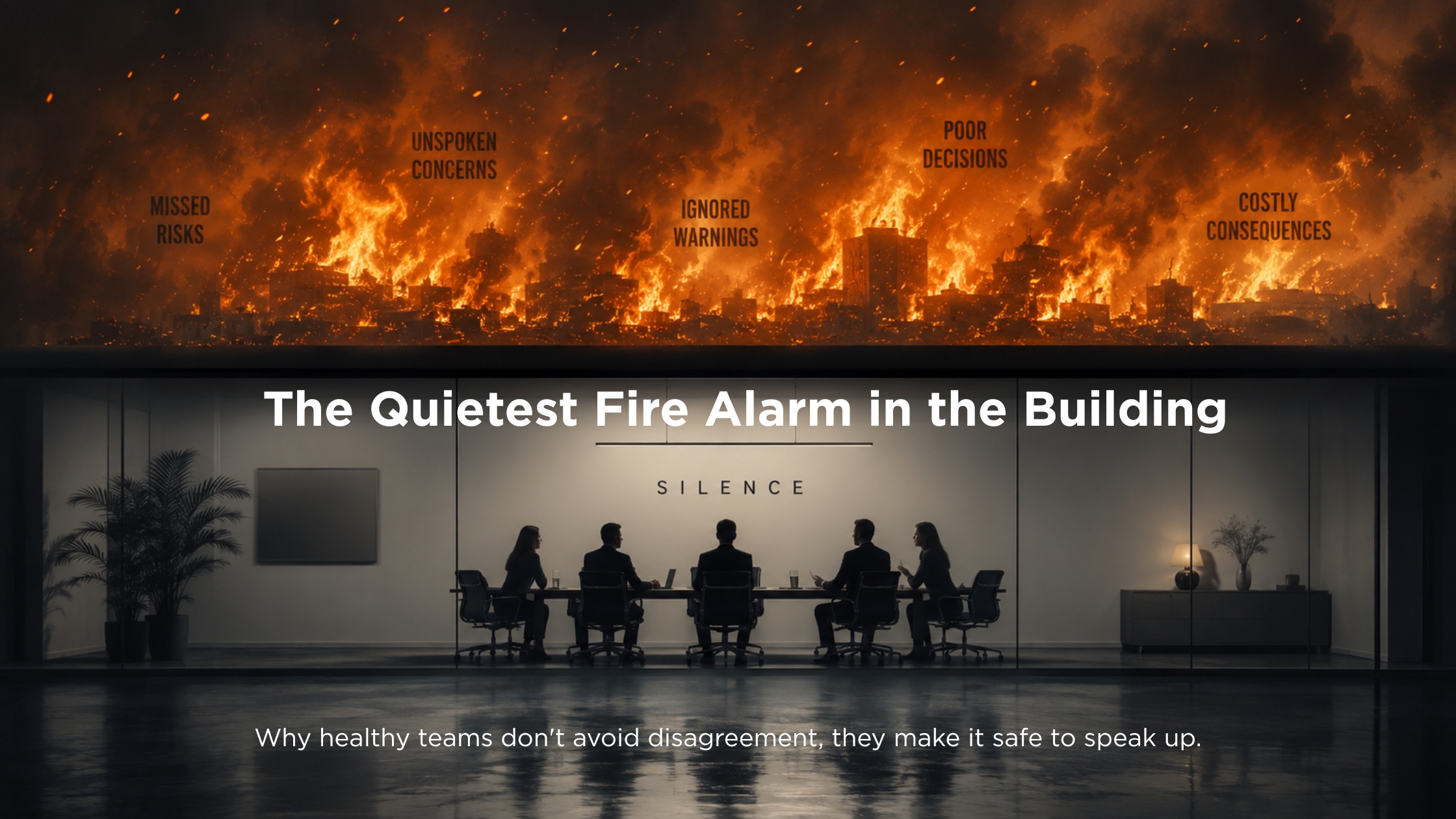
This is false harmony — a state where the absence of visible conflict is mistaken for organizational alignment.
It often appears in highly cohesive teams. Ironically, the stronger the relationships, the harder dissent can sometimes become.
Disagreeing with someone you like and respect can feel like more than a difference of opinion. It can feel like a threat to the relationship itself.
So people hold back.
Not necessarily because they fear punishment.
Sometimes, they simply don’t want to be the difficult one.
They don’t want to slow the meeting down. They don’t want to challenge the person everyone else seems to support. They don’t want to turn a good conversation into an uncomfortable one.
So the objection stays in their head.
The meeting moves on.
And the decision arrives faster than the truth does.
This is where groupthink can take hold: shared identity, strong cohesion, and an environment where dissent isn’t actively encouraged can produce agreement that feels good in the room but hasn’t been tested hard enough outside it.
And the consequences can extend far beyond a single meeting. When groupthink becomes a pattern, organizations can miss early warning signs, overlook changing customer needs, reject alternative ideas, and continue investing in decisions that no longer work. Over time, this can weaken an organization’s ability to adapt, and ultimately threaten its long-term sustainability.
The dangerous part?
There may be no obvious alarm.
No argument. No raised voices. No visible conflict.
Just silence.
What Constructive Friction Actually Looks Like
If false harmony is silence dressed up as agreement, constructive friction is its opposite.
It is disagreement made visible, but structured around the idea rather than the person.
It is questioning the plan, not someone’s competence. It is challenging an assumption without attacking the person who made it. And it is using evidence to strengthen a decision rather than ego to win an argument.
The goal isn’t to create more conflict.
It’s to make useful disagreement easier to express.
A few practices can help.
Make dissent part of the process.
A rotating “devil’s advocate” role gives someone an explicit responsibility to challenge the plan. The objection becomes part of the process rather than a personal act of resistance.
Require a written objection before sign-off.
Before finalizing an important decision, ask everyone to write down one reason the plan might fail. This gives quieter team members a way to surface concerns they may not raise aloud, and catches risks before they become post-mortem lessons.
Run a pre-mortem.
Instead of asking, “Any objections?” ask the team to imagine that the project has already failed.
Then ask: Why?
The question changes the dynamic. People aren’t being asked to oppose the plan. They’re being asked to investigate a hypothetical failure.
The dissent is still there.
It just has a safer doorway.
Separate the idea from the person who said it.
Hierarchy can make dissent especially difficult. A junior employee may see a flaw but hesitate to challenge a senior leader.
Leaders can make it easier to speak up by recognizing good ideas and challenges, no matter who raises them.
The strongest idea in the room should matter more than the status of the person who brought it forward.
The Leader’s Real Job
Psychological safety makes dissent possible.
It doesn’t make dissent happen.
That part belongs to leadership.
A manager who ends a meeting with, “Any objections?” may genuinely be inviting disagreement. But the question often comes too late, when it looks like the decision has already been made.
And when everyone else is quiet, speaking up can suddenly feel like volunteering to be the problem.
A manager who asks, “What am I missing?” creates a different dynamic.
The question assumes there is something worth finding.
It permits people to look for it.
This kind of differences matters.
Leaders who want constructive friction have to make it visible, and here’s how you can also do it:
- Thank the person who challenged the plan.
- Ask follow-up questions instead of immediately defending the decision.
Revisit decisions publicly when new evidence changes the picture. Most importantly, don’t let disagreement in the room become punishment outside it.
Employees don’t learn psychological safety from what leaders say about openness.
They learn it from what happens after someone speaks up.
Safety opens the door.
Leadership decides whether anyone feels safe enough to walk through it.
Harmony, Redefined
Now let’s think back to that new hire, bracing for the fallout after the Tuesday meeting.
It never came.
Nobody apologized. Nobody smoothed anything over, because there was nothing to smooth.
The disagreement wasn’t a disruption to the work.
The disagreement was the work.
True team harmony was never about how quickly people agree.
It’s about whether the path to agreement includes the difficult questions.
Whether people can challenge the data, question the assumption, test the plan, and raise the concern they would rather keep to themselves.
It means the strongest objection is heard before the decision is finalized — not discovered six months later as a lesson learned.
So the next time a meeting ends early because “everyone’s aligned,” it may be worth asking one more question:
Who in this room disagreed, and did we actually hear them?
Because sometimes the most dangerous fire alarm in a building isn’t the one making noise.
It’s the one that never gets pulled.