
“We should start using AI.”
Sounds like a smart decision.
Maybe it comes up in a leadership meeting. Maybe an employee discovers a tool that could save hours of work. Maybe a team wants to automate a repetitive process.
Soon, the conversation moves to tools, features, costs, and implementation.
But somewhere in the middle of all that excitement, one question can get missed:
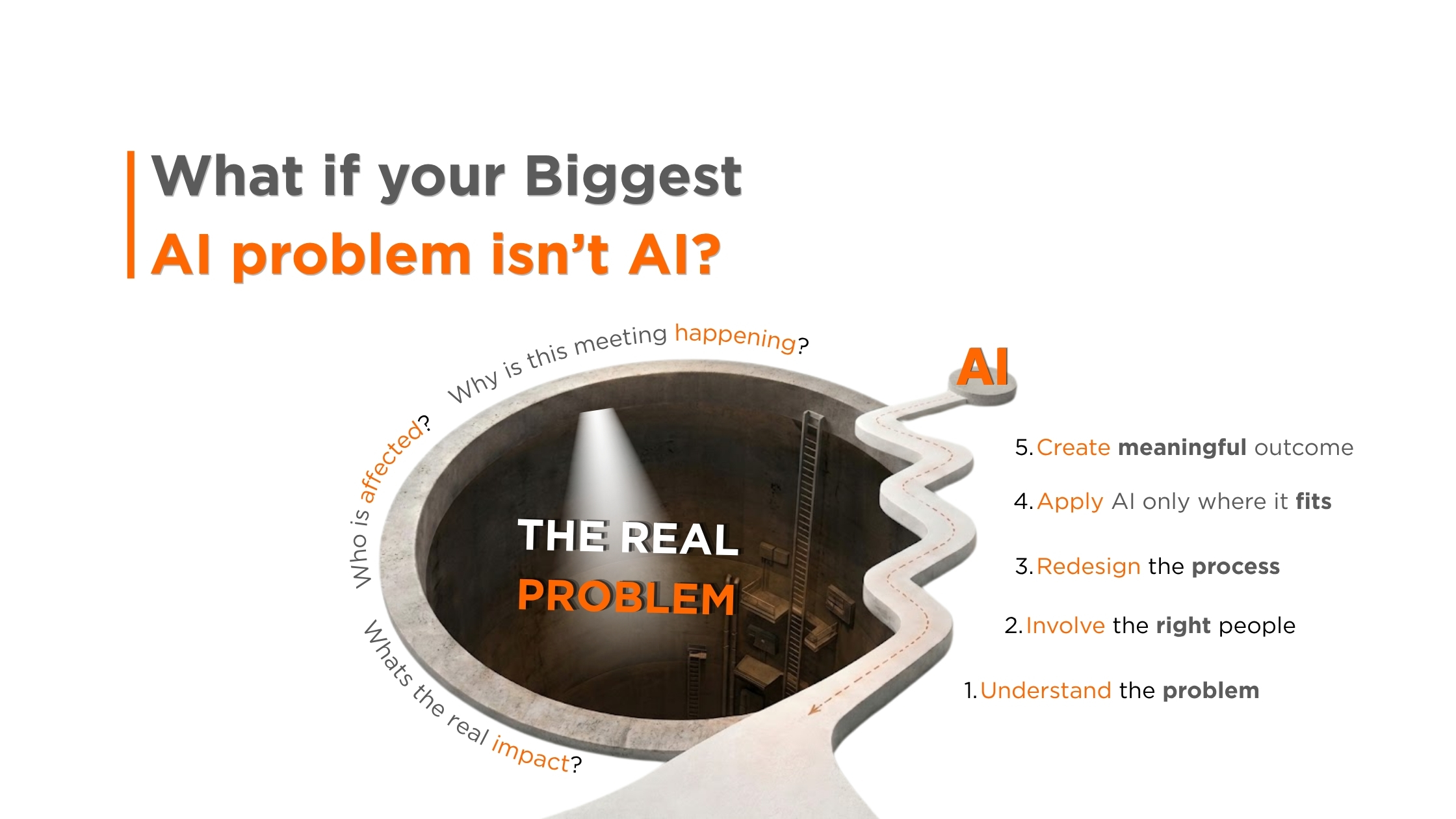
“What problem are we actually trying to solve?”
It may sound simple, but it can change the entire conversation.
Because sometimes, your organization doesn’t need more AI. It needs better questions and informed decisions.
AI can make work faster, smarter, and more efficient. But if we haven’t first understood the core problem, we risk using technology to solve the wrong thing—just faster.
The AI Rush Is Real
There is a reason organizations are excited about AI.
It can write, analyse, summarize, automate, generate ideas, and help people work differently.
And its adoption is also moving very quickly. McKinsey’s 2025 global survey found that 88% of respondents reported regular AI use in at least one business function, up from 78% the previous year. Yet nearly two-thirds said their organizations had not started scaling AI across the enterprise, and only 39% reported any enterprise-level EBIT impact.
This shows that there is an interesting gap:
AI adoption is growing.
But AI value is not growing at the same pace.
That doesn’t mean AI isn’t valuable.
It means using AI and creating value from AI are two different things.
And the difference often begins before the technology is even chosen.
Start With the Problem, Not the Tool
Imagine a team spending hours every week preparing a report.
The immediate reaction might be:
“Let’s use AI to automate it.”
Fair enough.
But then someone asks:
“Who actually uses this report?”
Silence.
Another person asks:
“Do we still need it?”
Now the conversation has changed.
The team isn’t solving an AI problem anymore.
They’re solving a process problem.
This is why the first question shouldn’t always be:
“What can AI do?”
Sometimes it should be:
“Why are we doing this in the first place?”
Harvard Business Review makes a similar point: in “Is AI the Right Tool to Solve That Problem?” (December 18, 2024), the authors emphasize that organizations should first identify which problems are actually suited to AI before choosing an AI solution.
Because the best technology cannot compensate for an unclear or poorly defined problem.
Sometimes, We Need to Look Closer
Think about a magnifying glass.
The greater and more powerful it becomes, the more detail you can see.
But there is one thing it cannot tell you:
What should you be looking at?
AI is putting organizations under a much stronger magnifying glass.
We can analyse more information, automate more tasks, generate more content, and move faster than before.
But if we’re looking at the wrong problem, a bigger magnifying glass won’t help us find the right answer.
It may simply help us see the wrong problem in greater detail.
That is why better AI capability needs to be matched with better problem definition.
Before asking:
“What can AI do?”
we need to ask:
“What do we actually need to solve?”
Who Actually Sees the Problem?
Now bring the people closest to the work into the conversation.
The manager sees unnecessary cost.
The employee says, “This takes me two hours every week.”
The customer-facing team says, “This information doesn’t actually help customers.”
IT says, “That part could be integrated.”
Someone else asks:
“Why are we collecting this information at all?”
Suddenly, everyone is looking at the same process differently.
And something important happens:
The problem becomes clearer.
The people closest to the work often notice things that aren’t visible from the top.
They know where customers get stuck.
They know which approval takes too long.
They know which system creates duplicate work.
They know which “simple” task quietly eats half a day.
They may not have the final solution.
But they often have answers to a crucial part of the question.
Better Questions Need More Voices
This is where co-creation becomes powerful.
Instead of leadership deciding:
“We need AI for this.”
Bring different perspectives into the room.
Ask:
What is actually happening?
Where is the friction?
What could be simplified?
What should remain human?
Where could technology genuinely help?
What would a better outcome look like?
A leader may see cost.
An employee may see workload.
A customer may see frustration.
An IT team may see a system limitation.
They are all looking at the same organization.
But they are seeing different parts of it.
When those perspectives come together, the organization can move from assuming the problem to actually understanding it.
And that changes the solution conversation completely.
AI Is Also a People Question
There is another part of AI transformation that can easily get overlooked:
People.
AI adoption isn’t simply about teaching employees how to use another tool.
It also depends on the environment around them.
Are processes clear?
Is the right data available?
Can teams experiment with new, risky ideas?
Do leaders support change?
Are employees encouraged to question old ways of working?
Do people understand what should be automated—and what still requires human judgment?
McKinsey’s research consistently points toward broader organizational capabilities—ways of working, talent and leadership, data, technology, and adoption—as important to capturing value from AI.
Because an AI-ready employee working in an AI-unready organization will still struggle to create impact.
Technology changes the tools.
Organizations have to change how they work with them.
So, What Does Successful AI Adoption Actually Look Like?
Successful AI adoption isn’t about collecting more AI tools.
It is about connecting technology to meaningful outcomes.
Organizations creating greater value from AI are increasingly looking beyond isolated experiments and toward redesigning workflows, building the right capabilities, embedding AI into business processes, and most importantly measuring whether those changes actually produce results.
That might mean reducing repetitive administrative work.
Helping teams analyse information faster.
Improving customer experience.
Supporting better decisions.
Or giving employees more time for work that requires creativity, judgment, and human connection.
The common thread is simple:
They don’t start with:
“Where can we put AI?”
They start with:
“Where can AI create meaningful value?” and “Do we actually need AI?”
And that changes the entire journey.
Problem → People → Process → AI → Outcome
Not:
AI → Find a use.
Five Questions Before the Next AI Tool
Before introducing another AI solution, pause for a moment:
1. What problem are we actually solving?
Not what tool do we want to use?
2. Who experiences the problem most closely?
Talk to the people closest to the work.
3. What does the current process look like?
Understand it before trying to automate it.
4. What should remain human?
Not everything needs to be automated.
5. How will we know it worked?
Define the outcome before celebrating the technology.
These questions sound simple.
But simple questions can expose complicated problems.
Because “We implemented AI” is not an outcome.
Faster service is.
Less rework is.
Better decisions are.
A better customer experience is.
More meaningful work for employees is.
The technology is not the outcome. The value is.
From Better Questions to Better Work
Maybe the next competitive advantage won’t come from being the organization with the most AI tools.
It may come from being the organization that knows where AI genuinely belongs.
At JDRC, this is where our work begins.
We don’t see technology as a solution that should simply be added to an existing process. We start by understanding the strategy, people, processes and problems behind the work.
Through our co-creation approach, we bring different perspectives into the room, make the current reality visible, identify where the real friction lies, and work with people to design practical solutions, not just impressive on paper.
Diagnose → Co-create → Design → Deliver → Sustain
Because meaningful transformation doesn’t happen when an organization simply adopts a new tool.
It happens when people understand why it matters, where it creates value, and how it changes the way work gets done.
So before your next AI conversation begins with:
“Which tool should we use?”
Maybe pause.
Ask a better question first:
“What problem are we actually trying to solve?”
Because AI can give your organization more capability.
Better questions help you turn that capability into value.