
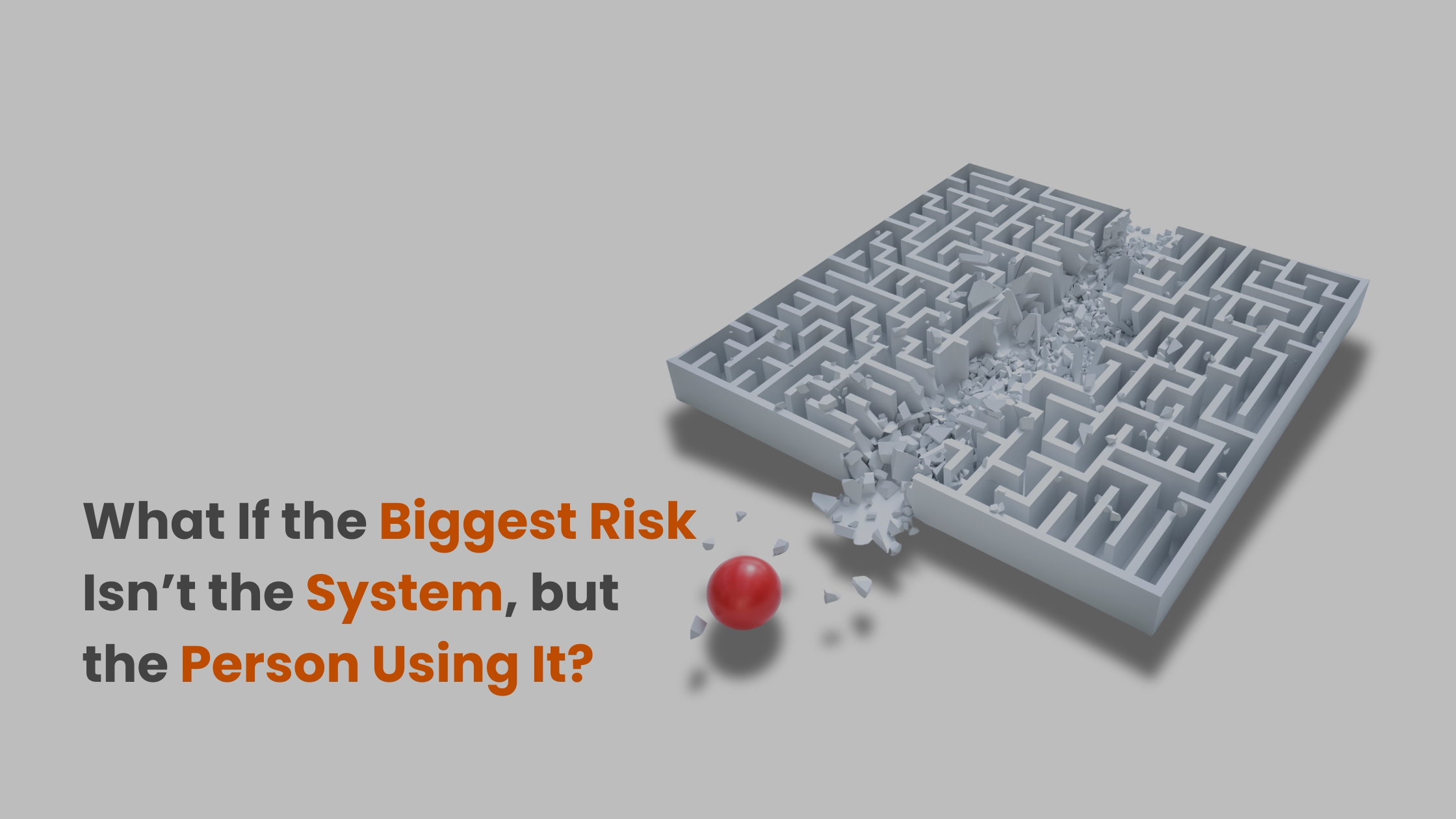
The Decision That Didn’t Feel Dangerous
It all started with a small decision.
The kind of that people makes every day at work.
A deadline was approaching. Pressure was building. The easy option seems to be harmless, and honestly, it just felt justified. Similar decisions had worked before. No one around seemed concerned. In fact, it almost felt like the “normal” way of getting things done.
So the shortcut was taken.
Nothing dramatic happened in the moment.
No alarms.
No immediate consequences.
No visible disruption.
But risk rarely announces itself when it enters.
It usually begins quietly, inside human judgment.
Not because someone intends harm, but because human thinking is shaped by invisible psychological forces.
We Don’t Make Decisions Like Machines
Workplaces often rely on systems, procedures, and controls. They are designed to bring structure and predictability.
But human behavior does not follow structure perfectly.
People bring everything with them into decision-making:
stress,
confidence,
fear,
Peer pressure,
ego,
past experiences,
and expectations from others.
Even in structured environments, decisions are still filtered through human perception.
This is where behavioral risk begins, not in systems failing, but in interpretation, judgment, and response.
Behavioral risk is not simply about wrongdoing. It is about how people naturally think under real-world conditions.
The Mind Prefers Shortcuts
Human beings are constantly making decisions, often faster than they realize.
To handle the complexity of everyday situations, the brain naturally looks for easier ways to process information. Instead of analyzing every detail carefully, people rely on mental shortcuts based on past experiences, familiar patterns, or quick assumptions.
These shortcuts, known as heuristics, are efficient, but not always accurate.
They quietly influence decisions in ways people rarely notice.
- A familiar situation feels “safe.”
- A repeated pattern feels “proven.”
- A quick judgment feels “obvious.”
- A past success feels like a guarantee.
Over time, these shortcuts can shape thinking in subtle ways:
- Confirmation bias filters what we choose to see,
- Familiarity bias increases trust in repeated actions,
- Overconfidence bias amplifies judgment accuracy,
- Availability bias makes recent experiences feel more important than they are.
To the individual, the decision still feels logical.
That is what makes behavioral bias so powerful; it rarely feels like bias while it is happening.
When “Normal” Starts Replacing “Right”
One of the most important shifts in behavioral risk happens gradually: normalization.
People do not usually wake up and choose to show risky behavior.
Instead, they adapt.
A small shortcut becomes routine.
A repeated exception becomes acceptable.
A questionable action becomes part of the workflow.
Silence becomes a habit.
Eventually, what once felt questionable no longer feels unusual at all.
Research on harmful events and misconduct in organizational environments done by Faugere and Stul in 2021 highlights that many serious breakdowns are not sudden failures. They are often the result of accumulated behavioral patterns shaped by cognitive biases, environmental pressure, and gradual normalization of risk-taking behavior.
The key insight is simple: people rarely perceive this shift while it is happening.
Because adaptation feels like efficiency, not risk.
When Silence Becomes Part of the System
Even when individuals notice that something feels “off,” they do not always speak up, and most of the time, it is because they fear that speaking up will create unwanted negative consequences for them
This is where psychological safety becomes essential.
Psychological safety, a concept extensively researched by the Harvard professor Amy Edmondson in 1999, refers to the shared belief that people can speak up, ask questions, raise concerns, or admit mistakes without fear of embarrassment, punishment, or social consequences.
In environments where psychological safety is low:
- people hesitate to challenge decisions,
- concerns remain unspoken,
- mistakes are hidden or rationalized,
- and risky behavior goes uncorrected for longer.
Importantly, silence is not always the absence of awareness.
Often, it is the presence of fear.
Even when individuals recognize risk, they may choose not to express it because the social or professional cost feels a lot higher than the benefit of speaking up.
Over time, this silence allows behavioral patterns to stabilize, even when they are misaligned with intended standards or expectations.
Psychological safety does not eliminate risk; rather, it determines whether the risk is visible early or discovered too late.
Emotions Are Always Present in Decision-Making
Another invisible driver of behavioral risk is emotion.
Workplaces often assume decisions are purely rational, but emotional influence is constant.
- Stress can narrow thinking.
- Fear can suppress communication.
- Confidence can reduce caution.
- Frustration can increase impulsivity.
- Success can create an overestimation of the capability.
Research by Yasmine Souissi and Anis Jarboui on emotional bias in leadership contexts in 2018 highlights that emotional states can significantly affect decision quality and organizational outcomes. While their focus is on leadership, the underlying principle extends broadly: emotions influence judgment at every level of decision-making.
This means decisions are rarely just technical; they are also psychological.
And psychological states shift constantly.
Risk-Taking That Doesn’t Feel Like Risk
Perhaps the most complex part of behavioral risk is that people do not usually see themselves as taking risks while they are doing it.
Instead, they rationalize:
“It worked before.”
“This should be fine.”
“We don’t have time.”
“Everyone does it this way.”
These internal narratives are powerful because they feel reasonable in the moment.
But they are often shaped more by bias, pressure, and environment than by objective evaluation.
This is where risk-taking becomes subtle, not reckless, but normalized.
And that normalization makes it harder to detect.
A Human-Centered View of Risk
This is where a different approach becomes important.
From a behavioral risk assessment perspective, JDRC focuses on understanding the human side of decision-making, not just the outcomes of decisions, but the psychological and behavioral processes behind them.
Rather than treating risk purely as a system failure, this approach looks at:
- how individuals interpret pressure,
- how biases influence judgment,
- how emotions shape decisions,
- how organizational environments reinforce or suppress behavior,
- and how silence or communication patterns affect risk visibility.
The goal is not to label any behavior as right or wrong.
It is to understand how risk emerges through human cognition and workplace dynamics.
Because most behavioral risk does not start as misconduct.
It starts as normal human decision-making under imperfect conditions.
The Risk We Often Miss
The most difficult part of behavioral risk is that it rarely appears extreme at the beginning.
It appears ordinary.
A quick decision. A small assumption. A minor shortcut. A moment of silence.
Individually, these seem insignificant.
But together, they shape patterns.
And patterns shape outcomes.
This is why behavioral risk cannot be understood only through systems or controls. It must also be understood through psychology, emotion, and environment.
Because systems do not make decisions.
People do.
And people are influenced by far more behavioral factors than they realize.
Where Risk Truly Begins
Perhaps the question is not whether systems are strong enough.
Perhaps the real question is:
What happens when perfectly normal people make perfectly understandable decisions under imperfect human bias?
Because in the end, the biggest risk is not always a structural failure.
Sometimes, it is the quiet intersection of human bias, emotional pressure, and silence, operating unnoticed until it finally becomes visible.