
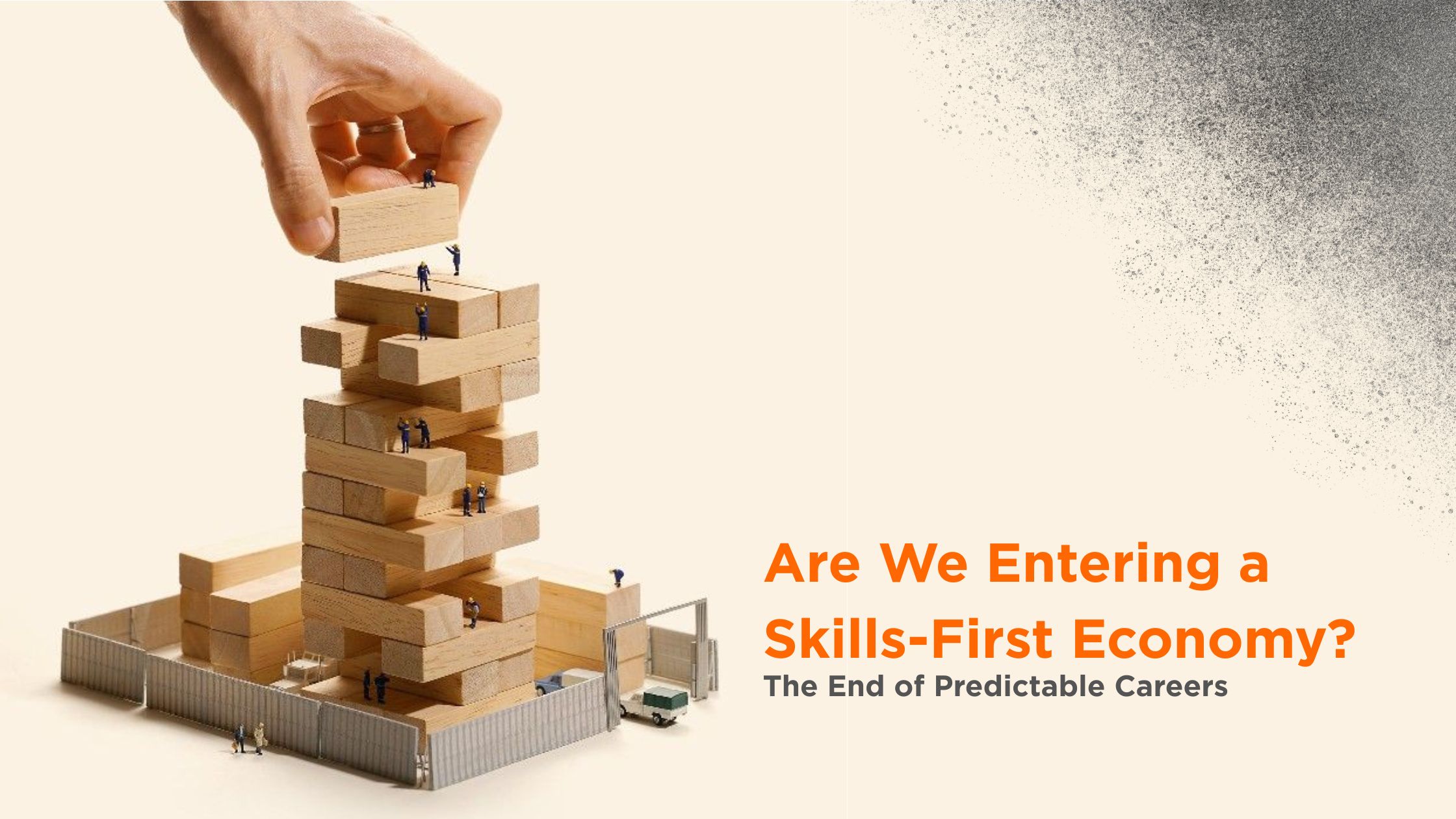
The End of Predictable Careers
Imagine asking a graduate in 2015 to prepare for jobs such as Prompt Engineer, AI Trainer, or Digital Brand Strategist.
Most people would have dismissed these as buzzwords or science fiction.
Yet today, these roles are real, growing, and reshaping industries.
This is perhaps the greatest challenge facing professionals and organizations alike: not simply keeping up with change, but preparing for opportunities that do not yet exist.
For decades, career advice was remarkably straightforward.
Choose a field carefully. Earn the right degree. Gain experience. Climb steadily upward. And, perhaps most importantly, have a five-year plan.
The logic made sense. Industries evolved gradually, technologies changed at a manageable pace, and career progression often followed a relatively predictable path.
But the world of work no longer moves at that pace.
Artificial intelligence is automating tasks once considered uniquely human. Digital transformation is redefining industries. New job titles emerge faster than universities can design courses around them, and skills that were highly valued a few years ago can quickly become outdated.
In this environment, predictability has become a luxury.
The question is no longer, “Where will work be in five years?”
The more pressing question is:
“How quickly can individuals and organizations adapt when work changes?”
This shift is giving rise to what many experts describe as a skills-first economy; an economy where the ability to continuously learn and apply new skills increasingly determines success.
The idea is simple yet profound: what individuals can do, how quickly they can learn, and how effectively they can adapt are becoming just as important as what they studied or how many years of experience they possess.
This does not mean that degrees have become irrelevant or that long-term aspirations no longer matter. Foundations remain important. Expertise still matters. However, in a rapidly changing world, foundations alone are no longer enough.
The ability to evolve may become the defining advantage of the future workforce.
Why the Traditional 5-Year Career Plan Is Under Pressure
For decades, the five-year career plan represented ambition and foresight.
It encouraged individuals to think strategically about their futures, map out milestones, and work steadily toward long-term goals.
But the five-year plan was built on an important assumption: that the future would resemble the present closely enough for long-term predictions to remain useful.
That assumption is becoming increasingly fragile.
Consider the tools that dominate workplaces today. A few years ago, generative AI, prompt engineering, AI-assisted design, and no-code automation were niche concepts discussed primarily by technologists. Today, they are influencing marketing, research, human resources, finance, and customer service.
The skills that employers seek are evolving rapidly, and professionals who once relied on static job descriptions often find themselves learning entirely new capabilities within a surprisingly short period.
Even organizations are struggling to predict which skills will be most valuable in the coming years.
This is not to say that long-term planning has become irrelevant. Rather, the nature of planning itself is changing.
According to Delle and Searle (2020), career adaptability is “the readiness to cope with predictable tasks of preparing for and participating in work role and with the unpredictable adjustments prompted by changes in work and working conditions.
The challenge, therefore, is not the absence of planning.
It is learning how to plan for uncertainty.
And perhaps the best way to prepare for uncertainty is not to predict every turn in the road, but to become adaptable enough to navigate whichever path unfolds.
The Rise of Micro-Upskilling
This is where micro-upskilling enters the conversation.
Micro-upskilling refers to acquiring focused, practical skills through short and targeted learning experiences.
Instead of returning to university as industries evolve, professionals invest in smaller learning sprints that immediately improve their effectiveness. Some of the examples include:
- Learning how to use an AI-powered research assistant.
- Mastering a new data visualization tool.
- Understanding workflow automation.
- Developing facilitation skills.
- Improving storytelling and business communication.
These are not necessarily life-changing educational commitments.
They are targeted investments.
Small enough to begin immediately.
Practical enough to apply tomorrow.
And powerful enough to compound over time.
The appeal of micro-upskilling lies not only in its accessibility but also in its philosophy.
It shifts the focus from prediction to preparedness.
Instead of attempting to forecast exactly where a career will be in five years, professionals invest in becoming adaptable enough to thrive across multiple futures.
The philosophy is simple:
Learn quickly. Apply immediately. Repeat continuously.
This approach recognizes an uncomfortable truth about modern careers: the most valuable skill is often not what someone already knows, but how effectively they can learn what comes next.
Increasingly, success is less about reaching a final destination and more about developing the capacity to evolve.
From Career Ladders to Skill Portfolios
This shift is changing how careers are defined.
For decades, career growth resembled climbing a ladder. Success meant moving upward through increasingly senior roles within a single profession or organization.
Today, careers increasingly resemble portfolios.
A finance professional may combine expertise in accounting, analytics, and AI tools.
An HR professional may blend people management with data literacy and digital transformation.
A researcher may combine subject matter expertise with storytelling, visualization, and technological proficiency.
A marketing manager may pair creativity with prompt engineering and automation.
Value is no longer created solely through specialization.
Increasingly, it emerges from the ability to combine diverse capabilities and adapt them to evolving contexts.
This is one of the defining characteristics of the skills-first economy.
Employers are not only asking:
“What degree does this person hold?”
They are asking:
“Can this person learn fast?”
“Can they adapt?”
“Can they solve emerging problems?”
The answers to these questions are becoming powerful predictors of long-term success.
Research from McKinsey & Company (Hancock et al., 2022) suggests that organizations are increasingly prioritizing skills-based approaches to talent development and workforce planning, recognizing that skill requirements are evolving faster than traditional talent pipelines can respond. Continuous learning is no longer viewed as a supplementary activity; it is becoming central to organizational competitiveness.
The implication is clear.
Careers are becoming less like predetermined journeys and more like ongoing experiments in learning, adaptation, and reinvention.
The JDRC Perspective: Learning as a Strategic Capability
Through our work with organizations and professionals across sectors, one reality has become increasingly clear: the challenge is no longer simply acquiring talent; it is developing talent that can evolve.
Organizations today are navigating a landscape shaped by technological disruption, changing workforce expectations, and rapidly evolving skill requirements. Roles are changing faster than job descriptions can keep pace, and the skills that create value today may need to be reimagined tomorrow.
At the same time, professionals are asking a different set of questions. Rather than seeking a single qualification that lasts a lifetime, they are looking for learning opportunities that are practical, flexible, and immediately relevant to their work.
This shift is particularly significant in emerging economies such as Nepal.
Digital transformation, remote work, and global talent mobility are reshaping what careers look like and where opportunities come from. Traditional career paths are no longer the only routes to success.
A young professional in Kathmandu can learn a specialized digital skill online and collaborate with clients across continents. An experienced manager can reinvent their expertise by embracing new technologies and ways of working. Small, targeted learning efforts can create opportunities that were difficult to imagine just a decade ago.
From JDRC’s perspective, micro-upskilling is not merely a trend in professional development.
It is becoming a strategic capability.
Organizations that cultivate a culture of continuous learning are likely to be more resilient in the face of change. Professionals who remain curious and adaptable are more likely to stay relevant, regardless of how industries evolve.
The future of work may not belong to those with the most carefully constructed career maps.
It may belong to those who make learning a habit rather than an event.
Stop Planning for 2031. Start Preparing for Next Monday.
Perhaps the five-year career plan is not dead.
But it is evolving.
In a world where technologies, industries, and skills are changing faster than ever, certainty is becoming less valuable than adaptability.
The professionals who thrive may not be those who know exactly where they will be in 2031.
They may be those who remain ready for whatever next Monday brings.
And perhaps that is the defining characteristic of a skills-first economy, not the disappearance of long-term ambition, but the recognition that the future belongs to those who never stop learning.