
AI can now do more than answer questions. It can plan, use tools, and move work forward. But as AI learns to work differently, are organisations learning to work differently with it?
Yesterday, your AI helped you write emails. Today, it can plan the next steps, use connected tools, and carry out tasks with far less hand-holding.
Imagine giving it a big job: preparing for an important client meeting. It gathers the client’s background, reviews past discussions, drafts the presentation, and lines up follow-up tasks. All before you’ve finished your morning tea.
Then the cracks show. The presentation has an outdated figure. The summary misses a concern the client raised last week. And a recommendation is already moving forward, though nobody has checked the information behind it.
Who was supposed to verify it? Who had the authority to approve it? If something goes wrong, who is accountable?
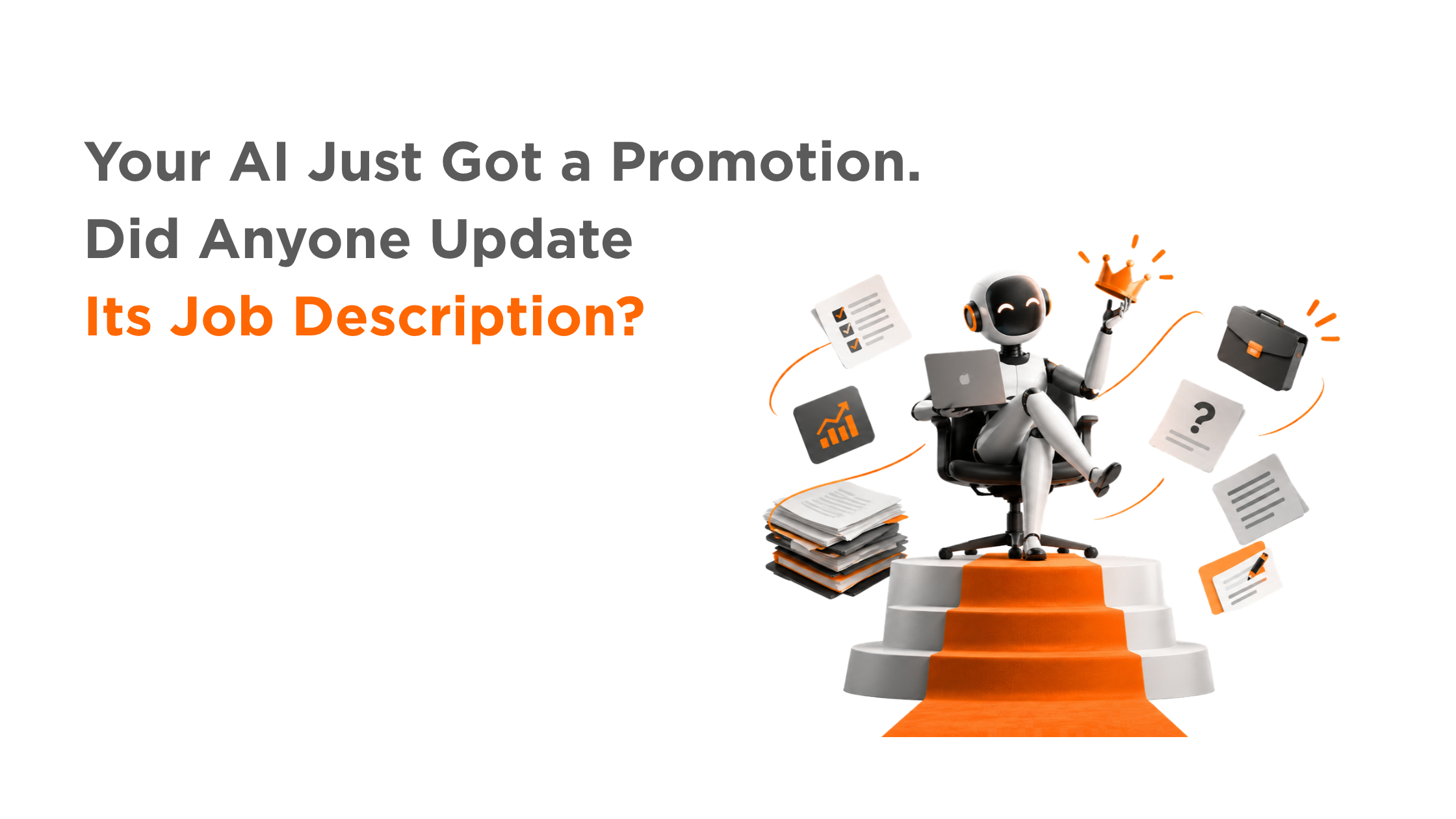
Your AI may have earned its promotion. But nobody updated its job description, redesigned the workflow, or clarified who owns the outcome. That is the real story behind agentic AI.
What is agentic AI?
Traditional AI responds to prompts. Agentic AI can work towards a goal: it plans connected steps, uses tools, and moves tasks forward within the permissions it has been given.
Traditional AI might help you plan a trip. Agentic AI could start organising it by checking options, coordinating steps, and carrying out approved actions. One helps you decide what to do. The other can start doing it.
So the question changes from “What can AI do?” to something more important: “How must we redesign work now that AI can do more?”
The relay race has changed. Has the team?
Picture a relay race. Every runner is fast, but if a handoff fails, the whole team loses.
Now put AI on the team as one of the runners. It prepares a report and hands it to an employee. The employee sends it for approval, and another system acts on the approved result. On paper, this is efficient.
But what if the AI passes along a wrong figure? What if the employee assumes someone else checked it? What if the next system acts before anyone notices?
The problem is no longer how fast each runner moves. It’s whether the team knows how to work together. AI is changing the speed and complexity of the handoff, and organisations need to rethink how it happens.
Faster work doesn’t always mean better results
In our client meeting, AI saved time on the presentation. But fixing the figure, chasing the missed concern, and rechecking the recommendation created new work. The time saved at the start simply moved elsewhere.
McKinsey’s The State of AI in 2026: On the Road to ROI shows the same pattern at scale. About 80% of respondents say AI has improved their personal productivity, yet only 37% report any positive contribution to their organisation’s earnings (EBIT), a share essentially unchanged from last year.
People are getting more done, but the business results aren’t following automatically.
The same research points to a clue. A small group of “high performers” (about 6% of respondents) stands apart: nearly three-quarters of them fundamentally redesigned their workflows around AI, compared with about a quarter of everyone else.
The lesson isn’t to adopt more AI. It’s to rethink how the work gets done. Here are three principles for getting the whole team moving together.c
1. Redesign the workflow, not just the task
It’s tempting to pick one task, automate it, and move on. But if AI drafts a presentation in ten minutes and an employee then spends an hour finding reliable data and chasing approvals, the process hasn’t really improved.
Step back and look at the whole journey. Where does the information come from? Who checks it? Which decisions need human judgement? Where does work get stuck? Which steps could be removed or combined?
Perhaps AI gathers information and drafts, while the employee focuses on understanding what the client really needs. Perhaps the approval chain can be shortened. The goal is not to squeeze AI into every existing step. It’s to build a workflow that uses both human and AI strengths well.
2. Make accountability part of the handoff
If an AI agent prepares a recommendation, another system schedules the follow-up, and an employee assumes it was approved, everyone has completed a step, yet nobody owns the check.
The answer isn’t to make people review every AI action by hand. It’s to set clear boundaries:
- What can AI do on its own? For example, drafting a client email.
- What needs human approval? For example, actually sending it.
- Who decides? For example, the final call on a financial or HR decision stays with an authorised person.
- When must work stop? If information is missing or conflicting, the task escalates for review.
The level of oversight should match the level of risk. Top Employers Institute’s report Designing Work for the Age of Agentic AI makes the same point: as multiple AI agents coordinate work, accountability and decision rights need to be rethought.
In a relay race, passing the baton isn’t enough. The next runner has to receive it clearly. And when something goes wrong, “the AI did it” can’t be the end of the conversation.
3. Build trust before expecting adoption
Consider an employee told that AI will take over part of their daily work. They may be glad to lose the repetitive tasks. They may also wonder: What am I still responsible for? Can I challenge an AI recommendation? Will I be blamed if I follow a wrong output? How will my role change?
These are reasonable questions, and a tool login or a policy read once won’t answer them. People need to understand what AI is used for, where its limits are, how their responsibilities may change, and when to rely on their own judgement. They also need room to practise and raise concerns without being labelled resistant.
Organisations are paying more attention to this. Top Employers Institute’s 2026 survey found that formal ethical AI frameworks among certified Top Employers rose from 42% in 2025 to 62% in 2026. But a written framework is only the start. Trust grows when expectations show up in everyday decisions and when leaders value quality and accountability as much as speed.
Put it in writing: the AI Handbook
Remember the AI that got promoted without a job description? Here’s how to fix it.
Most organisations have a handbook for people. Few have one for how people and AI work together. An AI Handbook is a short, living document, ideally one or two pages per workflow, that makes the rules of engagement visible to everyone. It doesn’t need to be a heavy policy manual. A new team member should be able to read it in ten minutes and know how things work.
A good AI Handbook answers six questions:
- Purpose: What is AI being used for in this workflow, and what is it not for?
- Role: What can AI do on its own, what needs human approval, and what is off-limits?
- Ownership: Who is accountable for the quality of the output, the final decision and the outcome?
- Data Security: What information can AI access, and what must stay protected?
- Escalation: When must AI or a team member stop and ask for review?
- People: How can employees question an AI output, raise concerns or ask for training without being blamed?
Here’s what one entry could look like for our client meeting:
| AI can do independently | Gather client background, summarise past discussions, draft the presentation |
| Needs human approval | Final figures, recommendations, anything sent to the client |
| Off-limits | Sending client communications, changing records, sharing confidential data |
| Accountable owner | The account manager (final content), the team lead (approval) |
| Escalate when | Data is missing or conflicting, or a figure can’t be traced to a source |
| Review rhythm | Check the handbook after the first month, then quarterly |
A handbook also builds trust. Employees can see what is expected of them and what they’re allowed to question. Leaders can see where responsibility sits. When something goes wrong, the team has a shared reference instead of finger-pointing.
Three tips:
- Start small. Write a handbook for one workflow, test it for a few weeks, and then refine it before scaling.
- Co-write it with the people who do the work. A handbook imposed from above gets ignored, while one built with employees gets used.
- Measure more than time saved. Has quality improved? Has rework dropped? Are decisions clearer? Do people understand their roles? Use the answers to update the handbook.
The Top Employers Institute report points in the same direction. It highlights consistent standards for transparency, data protection, and psychological safety, supported by cross-functional governance. The AI Handbook is a simple way to make those standards real in daily work.
Back to the client meeting
Let’s replay our story with these ideas in place.
The AI still gathers the background and drafts the presentation. But now the workflow is redesigned first, so reliable data is available before the task starts. The handbook says the AI can draft but not send, and that any figure it can’t trace to a source triggers a review. The Account Manager owns the final content, the Team Lead approves it, and everyone knows it’s fine to question the output.
The outdated figure is caught before the meeting. The missed concern is flagged for a human to follow up. And nobody wonders who was supposed to check.
Notice what changed. The AI didn’t get smarter. The organisation got clearer.
This is something we see at JDRC. AI rarely creates brand-new organisational problems. It exposes old ones faster: unclear ownership, slow approvals, disconnected information, and people unsure of their role. These are the strategic bottlenecks our work is built to decode, using a mix of human diagnostics and practical enterprise methods. AI just raises the stakes of getting them right.
That’s why we approach AI the same way we approach any change:
Diagnose → Design → Deliver → Sustain.
- Diagnose: Understand how the work really flows today, where handoffs break and where responsibility blurs.
- Design: Redesign the workflow and write the AI Handbook with the people who will use it.
- Deliver: Put it into practice with the right training, support and decision rights.
- Sustain: Review results, listen to employees and keep adjusting as the technology evolves.
The real race isn’t against AI
AI will keep getting more capable. But organisations don’t need to turn every employee into a faster runner or every process into an automated one. They need to help the whole team perform better by redesigning work instead of just adding tools, making accountability clear at every important handoff, and giving people the confidence to work responsibly with AI.
The organisations that win won’t necessarily be the fastest to adopt AI. They’ll be the ones that turn its capabilities into better decisions and stronger processes.
AI may be ready to take the baton. Is your organisation ready for the handoff?
Want to build an AI Handbook for your team’s workflows? Talk to JDRC about a workflow diagnostic: 971-2060675
Sources:
McKinsey & Company, The State of AI in 2026: On the Road to ROI (August 2026) ·
Top Employers Institute, Designing Work for the Age of Agentic AI (2026)