
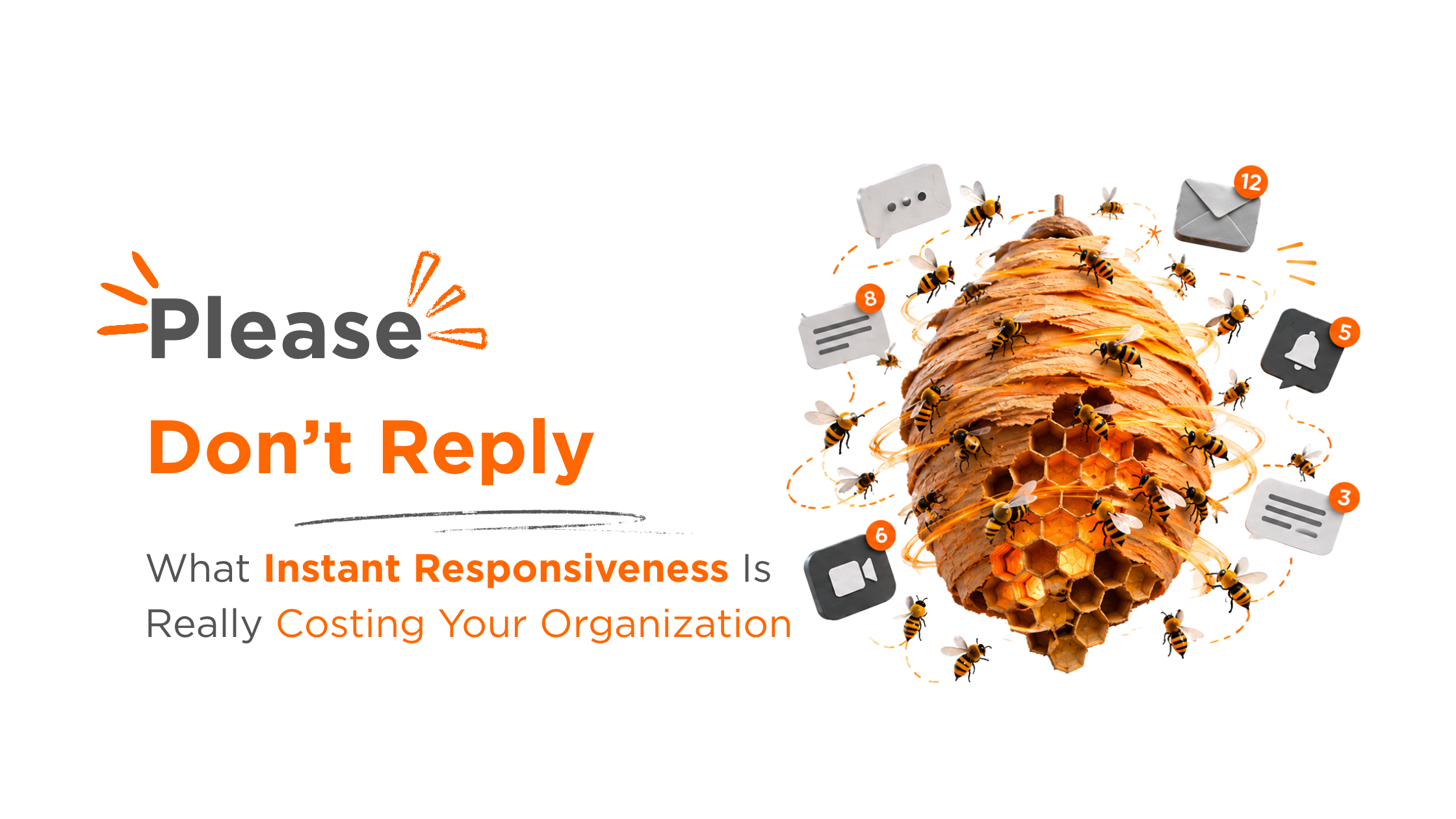
When we start an engagement with a leadership team, we often ask if we can see their priorities list, calendars, and message volume for a typical week. Across many organizations, many professionals, many leaders, one thing is common: numerous messages, dozens of “quick syncs,” and very little uninterrupted time for the work their organizational strategy depends on. And here’s the quick catch: you might be thinking these organizations, their leaders, their staff are very disorganized and lazy. But we are afraid to say ‘you are absolutely wrong’.
In contrast, organizations and teams like this are highly responsive, but the core issue is that they have confused higher responsiveness with higher productivity. And for several organizations, that confusion is now one of the most expensive and least visible costs on their financial statements.
The Illusion of Productivity
It is a no-brainer that instant communication tools reward visible activity: green dots, blue ticks, fast replies, ‘OK’ and ‘heart’ emojis. These tools have made it very easy to measure responsiveness, but what about measuring the quality of thinking? Often the answer is ‘Oops’. As such, the organizations knowingly or unknowingly drift toward what they can see instantly, and eventually motion starts to look like organizational progress and a hike in productivity.
Microsoft’s Work Trend Index has repeatedly found that these days employees feel constantly interrupted and are falling short on uninterrupted focus time. In his book, A World Without Email, Cal Newport calls this the “hyperactive hive mind,” where work is often organized around unstructured, instant messaging, where everyone is always half-available to everyone.
If we delve into this from an operating-model perspective, we can say that it is a design problem rather than a discipline problem. It is because no employee chose this way of working but it slowly got accumulated through default settings inside any organization
The 30-Second Notification That Costs You 20 Minutes
All of us have multiple notifications popping up at work throughout the day and sometimes even during off-hours. If you have noticed, it just takes about 30 seconds to look at it and answer. Yes, you are right. But have you ever thought about what the real cost behind it is that is always hidden? If not, here’s how it happens:
- Attention Residue: Sophie Leroy’s research shows that when you switch tasks, part of your attention stays stuck on the previous one, and your performance on the new task suffers (Leroy, 2009).
- Recovery time: Gloria Mark’s field studies state that if anyone is interrupted while doing a particular task, it can take over 20 minutes to return back to the same task in the same thinking flow (Mark, Gudith & Klocke, 2008). Her book Attention Span explores this in depth.
- You don’t even have to reply: Several researchers have found that merely receiving a notification, without touching the phone, was enough to measurably disrupt performance on an attention-demanding task (Stothart, Mitchum & Yehnert, 2015).
- Presence alone drains you: Even a silenced phone sitting on the desk can reduce available cognitive capacity (Ward et al., 2017).
So when we look at the statement “30 seconds ruins 20 minutes,” it looks like a simplified fact but actually this fact is a defensible one. Imagine an organization with 200 people; now multiply it across the organization, with the approximate number of times each person is interrupted during the workday. So you can see for yourself that the actual embedded cost of fragmented employee (including leaders) attention is bound to be larger than most of the line items in the key financial statements that any organization’s leadership reviews every quarter.
Why Not Every Message Needs an Instant Reply
You need to understand that of all the messages and notifications you receive in your workday, most of them are never emergencies. They just feel urgent because the tool delivers them like an emergency or early warning trigger, often with a sound, a badge, and an implied social expectation attached to it.
At JDRc, we help clients replace that ambiguity with explicit response expectations, much like a service-level agreement for internal communication, and for this one of the tools that we highly recommend is the Eisenhower Matrix. The idea behind this Matrix originated in 1954, when Eisenhower, while addressing the Second Assembly of the World Council of Churches, said that he had two kinds of problems: the urgent and the important, and the urgent that are not important. As such, he drew a four-quadrant grid of this idea, which is very relevant to this day:
| Urgent | Not Urgent | |
| Important | Do now. Crises, deadlines, client emergencies | Schedule. Strategy, deep work, relationships, planning |
| Not Important | Delegate. Most pings, many meetings, other people’s priorities | Eliminate: Chatter, busywork, idle scrolling |
What we need to understand here is that urgent tasks are the ones that demand our immediate attention and thus trigger our reactive mode, while on the other hand, important tasks are the ones that connect us directly to the long-term objectives of our work and our organizations.
So with a ‘constantly-on ‘ mode in the organization among teams and employees, it is easy for individuals to feel that Quadrant 3 is Quadrant 1. When a message arrives with a sound and a badge, it obviously feels urgent even when it isn’t important at all. Meanwhile, Quadrant 2, where deep work lives, never sends a notification and, as a result, it gets squeezed. As a result of this, employees and teams end up doing this:
- Urgent and important is Quadrant 1: interrupt and use a phone call. Example: a client crisis or a production halt; can be handled with a defined communication channel
- Important but not urgent is Quadrant 2: reply within hours, and protect the thinking time. Example: project-related questions that are perfectly fine to reply within a few hours
- Neither is Quadrants 3 and 4: batch it, delegate it, or drop it. Example: FYIs, reactions, quick hello chatters that can wait till a scheduled check
An instant reply is a choice, and often a bad trade because it signals that a colleague’s convenience outweighs your deep thinking. Much more than that, it trains the entire organization to expect the same speed and response every time. Often, the leaders of the organization set this tone. When executives reply within seconds, everyone below them learns that speed is the generally accepted behavior.
Analog Focus as a Competitive Advantage
Newport’s Deep Work argues that the ability to concentrate without distraction on cognitively demanding tasks is becoming both rarer and more valuable in modern workplaces. This is becoming truer now, especially with the advent of AI and automation. These dynamic systems often commoditize fast while generating shallow output, so what stays scarce is sustained, original thinking: strategy, complex problem-solving, and craft.
We call the response digital sovereignty, i.e., deciding deliberately when and how technology gets your attention, rather than default settings of letting each technological platform decide for you. And when this moves to the organizational level, this becomes more of a capability to build, rather than any individual employee’s personal habit.
What do we have to say to the leaders?
- Redesign the defaults: Notifications off by default, with scheduled check-ins for chat tools
- Protect “analog” time: Block 2-3 hours of focus time daily, with no apps and just a notebook, and treat it as seriously as a client meeting.
- Define an escalation path: Anything needing a reply in under an hour gets a call, not a message.
- Write for fewer follow-ups: Clear, complete messages stop threads from spiraling.
- Lead visibly: Model slower, more deliberate responses to give everyone else permission to do the same.
- Measure what matters: Track outcomes and decision quality rather than response times.
However, it is to be noted that the aim is not fewer messages for their own sake, but more of the work that keeps the pace and growth of the organization.
5 Key Takeaways
- Responsiveness is not productivity. Fast replies are visible, but meaningful output is what actually matters.
- Interruptions cost far more than their duration. Attention residue and recovery time mean a 30-second ping can derail 20+ minutes of focus.
- Even unread notifications hurt. The mere arrival of an alert, or the presence of a phone, can degrade concentration.
- Default to asynchronous, by design. Set explicit response norms and a separate channel for true emergencies, and let leaders model them.
- Focus is a strategic asset. In the age of automation, sustained deep work is a competitive advantage for individuals and organizations alike.
How does your organization decide what deserves an immediate response? We’d love to hear what’s working for your teams.
References
Leroy, S. (2009). Why is it so hard to do my work? Organizational Behavior and Human Decision Processes. https://doi.org/10.1016/j.obhdp.2009.04.002
Mark, G., Gudith, D., & Klocke, U. (2008). The cost of interrupted work. CHI ’08. https://doi.org/10.1145/1357054.1357072
Stothart, C., Mitchum, A., & Yehnert, C. (2015). The attentional cost of receiving a cell phone notification. Journal of Experimental Psychology: Human Perception and Performance. https://doi.org/10.1037/xhp0000100
Ward, A. et al. (2017). Brain Drain: The mere presence of one’s own smartphone reduces available cognitive capacity. Journal of the Association for Consumer Research. https://doi.org/10.1086/691462
Newport, C. Deep Work and A World Without Email: https://calnewport.com/
Mark, G. Attention Span: https://gloriamark.com/
Microsoft Work Trend Index: https://www.microsoft.com/en-us/worklab/work-trend-index
Eisenhower, D. D. (1954). Address at the Second Assembly of the World Council of Churches, Evanston, Illinois. The American Presidency Project: https://www.presidency.ucsb.edu/node/232572
Quote Investigator, “What Is Important Is Seldom Urgent and What Is Urgent Is Seldom Important”: https://quoteinvestigator.com/2014/05/09/urgent/
ClearanceJobs, “The Great Decider: Setting Priorities with the Eisenhower Box”: https://news.clearancejobs.com/2021/10/26/the-great-decider-setting-priorities-with-the-eisenhower-box/