
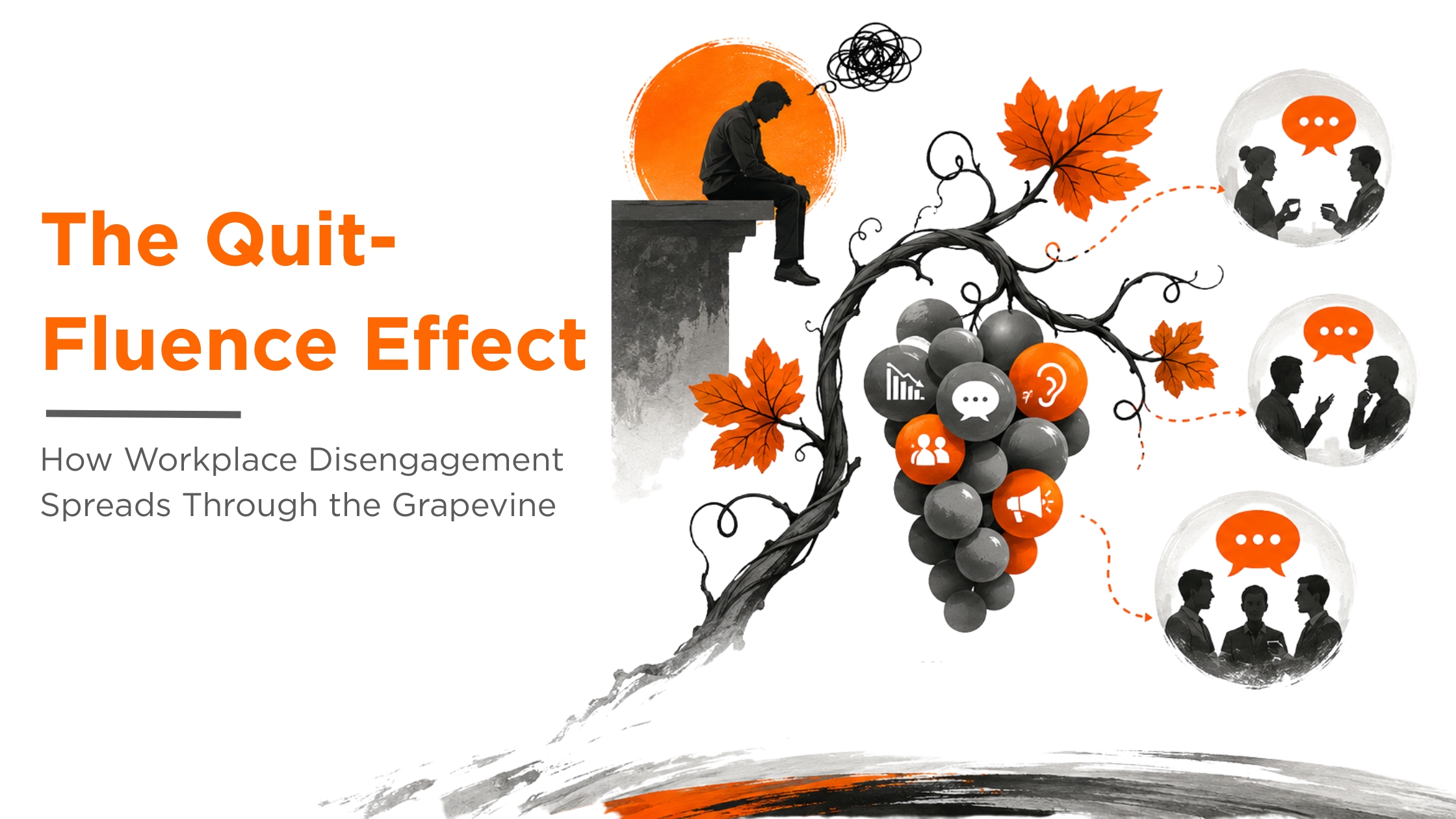
Is low morale contagious? I believe it can be. And sometimes, the person who starts the chain reaction is not the most disengaged employee in the room—it is the person everyone else respects.
In JDRC’s work with a variety of organizations in a series of diverse projects, we have often encountered a pattern that we find increasingly interesting.
People don’t always leave an organization when they resign.
Often, they leave much earlier—psychologically.
It starts quietly.
Someone who was once vocal in meetings becomes quiet. Someone who regularly challenged ideas starts saying, “It’s fine.” A person who was always willing to take ownership begins doing only what is expected.
Nothing dramatic has happened.
They are still coming to work. They may still be meeting their targets. There may be no formal complaint against them.
But something has changed.
And their colleagues usually notice.
This is what I call the “Quit-Fluence” effect—the way one person’s disengagement can gradually influence how others perceive their workplace, their leaders, and even their own future in the organization.
And this is where the grapevine becomes very powerful.
The Grapevine Doesn’t Just Carry Information. It Creates Meaning.
Every organization has a formal communication system. There are meetings, emails, policies, town halls, performance discussions, and formal HR communications. But there is another communication system operating alongside all of that.
The conversation after the meeting.
The chat message between colleagues.
The discussion over coffee or tea
And the quiet question:
“What do you think is really happening?”
That is the organizational grapevine.
The grapevine is not necessarily a bad thing but simply a part of how people make sense of their workplace.
The problem begins when there is a significant gap between what the organization communicates formally and what employees experience informally.
That gap gets filled.
Suppose a highly respected employee suddenly becomes disengaged.
People may not know why.
But they will try to make sense of it.
Did something happen?
Is management treating people differently?
Is there something we don’t know?
Should I also start thinking about my options?
The employee may never have said any of these things.
But their behaviour has become a signal.
Behaviour becomes information.
Information becomes interpretation.
Interpretation becomes a story.
And stories travel.
This Is Where Psychological Safety Comes In
This is also why we think the conversation about psychological safety is so important.
Amy C. Edmondson and Michaela J. Kerrissey, in their 2025 Harvard Business Review article, “What People Get Wrong About Psychological Safety,” make an important distinction: psychological safety isn’t about making everyone comfortable or avoiding disagreement. It is about creating conditions where people can contribute candidly and take interpersonal risks. HBR — “What People Get Wrong About Psychological Safety”
Think about that in a real workplace.
If I feel safe with my manager, I might say:
“I don’t agree with this decision.”
Or:
“I think we are approaching this the wrong way.”
Or even:
“I’m frustrated. Can we talk about it?”
But if I don’t feel safe, I may still need to have that conversation.
So I have it with a colleague.
And that colleague may have it with someone else.
This is where the grapevine becomes more influential—not necessarily because employees are spreading rumours, but because people need somewhere to process what they are experiencing.
What Happens When Someone Speaks Up?
There is another HBR article that we find particularly relevant here.
In “When a Team Member Speaks Up — and It Doesn’t Go Well,” Megan Reitz and Amy C. Edmondson discuss what happens when an employee takes the risk of speaking up, and the response is negative. One consequence is that people can become less willing to speak up in the future. HBR — “When a Team Member Speaks Up — and It Doesn’t Go Well”
From an organizational perspective, this has an important implication for leaders.
When one person speaks up and gets dismissed, criticised, or labelled as “negative,” the lesson isn’t received only by that person.
Everyone in the room is watching.
They are learning:
Is this what happens when you disagree?
And the next time, perhaps fewer people will speak.
The concern hasn’t necessarily disappeared.
It has simply moved somewhere else.
That is how a communication issue can gradually become an engagement issue.
And eventually, a retention issue.
The Resignation Letter Is Often a Lagging Indicator
This is why JDRC takes a cautious approach when organizations look at employee turnover as the primary measure of employee engagement.
Turnover tells us who has left.
It doesn’t necessarily tell us when they started leaving the organization psychologically.
By the time a high-performing employee resigns, there may already have been months of reduced discretionary effort, frustration, withdrawal, and informal conversations.
And if that person is influential within the team, their departure—or even their disengagement—can have an effect beyond their individual role.
We usually think of high performers as influential because of what they deliver.
But they also influence people through what they say, tolerate, question, and model.
That is why the disengagement of a respected employee can be more consequential than the disengagement of someone with little influence within the team.
Their colleagues are watching.
So What Should Leaders Do?
The answer lies not in controlling the grapevine.
We can’t—and we shouldn’t try to.
People will always talk.
The more useful question is:
Are we creating an environment where people can have the important conversations directly with the organization?
Can someone say:
“I disagree.”
Can they ask:
“Why are we doing this?”
Can they admit:
“I made a mistake.”
Can they say:
“I’m concerned about where this is going.”
And can they do all of that without being branded as difficult, disloyal, or negative?
Because psychological safety isn’t created by putting “We encourage open communication” on a wall.
It is created by what leaders actually do after someone speaks.
That is the part organizations sometimes underestimate.
You can invite people to speak.
But if you punish forthrightness when it arrives, you have communicated something much stronger than the invitation.
You have shown people what speaking up really costs.
They will remember.
And they will talk.
My 5 Takeaways
1. Disengagement is an early communication signal.
Don’t wait for the resignation letter. Changes in participation, initiative, and enthusiasm may tell you something is changing much earlier.
2. The grapevine is a part of your organizational communication system.
You may not control it, but the quality of your formal communication influences what the informal network has to interpret.
3. Psychological safety determines where difficult conversations happen.
When people feel safe, concerns can move upward. When they don’t, they often move sideways—to people they trust.
4. Your most influential employees can shape culture without saying much.
A respected employee’s withdrawal can become a signal that others interpret and respond to.
5. Don’t try to eliminate the grapevine. Make it less necessary.
Build trust, transparency, and psychological safety so employees don’t have to rely primarily on informal conversations to understand what is happening around them.
Ultimately, organizational culture isn’t built only through HR policies, values statements, or leadership presentations.
It is built through everyday interactions.
Through what happens when someone disagrees.
Through how a manager responds to bad news.
Through whether people feel heard.
And through the stories employees tell each other about those experiences.
So perhaps leaders need to ask two questions—not just one:
“What are we communicating?”
And perhaps the more revealing question:
“What are our people communicating to each other when we’re not in the room?”
Because sometimes, the earliest sign that an organization is losing its people isn’t a resignation.
It’s a change in the conversation.
HBR references
- Amy C. Edmondson & Michaela J. Kerrissey, “What People Get Wrong About Psychological Safety,” Harvard Business Review, May–June 2025. HBR article
- Megan Reitz & Amy C. Edmondson, “When a Team Member Speaks Up — and It Doesn’t Go Well,” Harvard Business Review, July 12, 2024. HBR article
- Amy Gallo, “What Is Psychological Safety, Really?” HBR on Leadership, July 10, 2024. HBR article
#Leadership #OrganizationalCulture #PsychologicalSafety #EmployeeEngagement #GrapevineEffect #WorkplaceCulture #HR #LeadershipDevelopment