
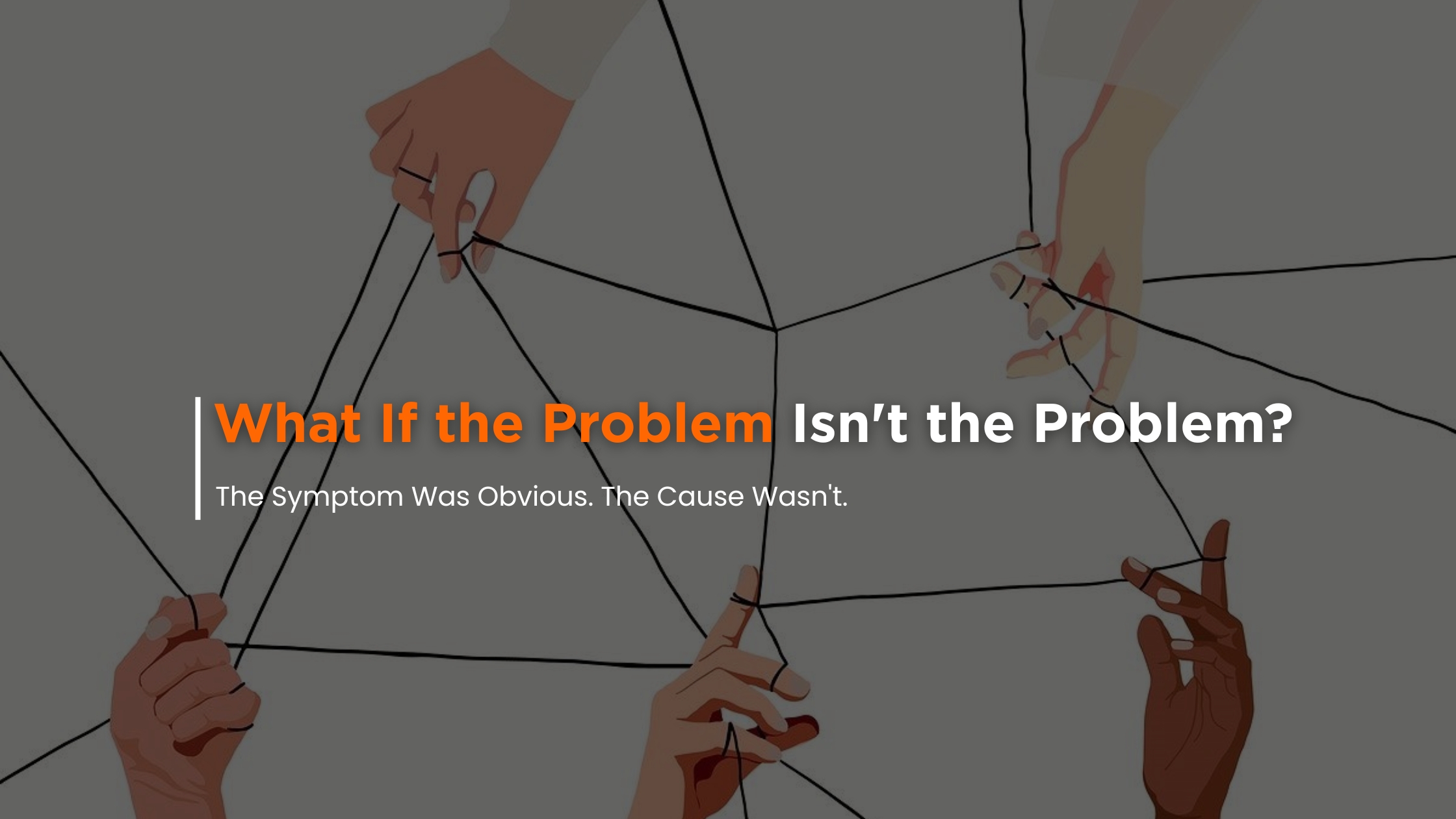
The Symptom Was Obvious. The Cause Wasn’t.
Imagine walking into your house one morning and finding water all over the floor.
Your first instinct? Grab a mop.
So you clean it. A few hours later, the floor is wet again. You mop it again. The next day, the same thing.
At some point, you stop asking “How do I clean this faster?” and start asking “Where is the water actually coming from?”
Because no matter how efficient you become at mopping, you will never solve a leaking pipe.
Strangely enough, many organizations spend years doing exactly that. Mopping the floor. Treating symptoms. Responding to what is visible. Working incredibly hard on solutions, without fully understanding what is creating the problem in the first place.
The Workplace Mystery Nobody Talks About
A team keeps missing deadlines. Employees keep resigning. Customers keep complaining. Departments keep blaming each other.
The symptoms are obvious. Everyone can see them. And usually, everyone has a solution ready.
“We need training.”
“We need a new system.”
“We need stricter accountability.”
“We need more people.”
Action plans are created. Initiatives are launched. Progress feels like it is happening.
Then a few months later, the same issue quietly returns. Maybe in a different department. Maybe with a different name. But it returns.
And that is often the moment organizations discover an uncomfortable truth: the symptom was obvious. The cause was not.
Every Organization Has a Crime Scene
Imagine a detective arriving at a scene and finding broken glass on the floor.
Now imagine if the detective immediately concluded: “The broken glass is the problem. Case closed.”
Sounds absurd, right?
Because broken glass is not an answer. It is evidence. It is a clue pointing toward something deeper. The real investigation begins when someone starts asking questions:
- What happened?
- Why did it happen?
- What are we missing?
Organizations face this same challenge every single day.
High turnover is a clue. Low engagement is a clue. Poor performance is a clue. Missed targets are a clue. Resistance to change is a clue.
The mistake is assuming the clue is the cause. Because what is visible on the surface is almost always the result of something happening underneath it.
Why Smart Organizations Still Solve the Wrong Problem
This does not happen because leaders do not care. It happens because people naturally focus on what they can see.
Visible problems create urgency. Root causes require investigation. An investigation takes time.
Solutions feel productive. Diagnosis feels slow.
Launching a new initiative feels productive. Running another workshop feels productive. Buying a new system feels productive. Introducing a new policy feels productive.
But activity and progress are not always the same thing.
Sometimes the most valuable thing an organization can do is pause long enough to ask better questions, because the organizations that improve sustainably are rarely the ones that solve problems the fastest. They are the ones who understand problems the most deeply.
When the root cause becomes clear, solutions become more targeted, more meaningful, and far more likely to last.
The Real Cost of Solving Symptoms
A communication workshop may not solve unclear accountability. More supervision may not solve a lack of trust. New technology may not solve poor processes. Additional hiring may not solve inefficient workflows.
Organizations often invest significant time, energy, and resources in solving what they can see, while the actual cause continues operating quietly in the background.
And the cycle repeats. New initiative. Temporary relief. Same problem, new name.
A Small Reflection
Think about a challenge your team or organization is currently facing.
Now ask yourself:
- What problem are we trying to solve?
- How do we know that is the real problem?
- What evidence do we have?
- What assumptions are we making?
- What might we be overlooking?
- If we asked “why?” five more times, where would it lead?
Sometimes the first answer explains the symptom. The fifth answer explains the cause.
What This Means Going Forward
Organizations today are operating in increasingly complex environments. Teams are evolving. Technology is changing. Employee expectations are shifting. And in that complexity, the pressure to act quickly is everywhere.
- When performance drops, fix it.
- When people leave, solve it.
- When projects stall, change something.
Action feels productive. But sustainable improvement rarely starts with action alone. It starts with understanding.
A solution built on the wrong diagnosis may create activity, but a solution built on the right diagnosis creates impact.
That is why meaningful organizational growth is rarely a straight line from problem to solution. It begins with curiosity.
- With investigation.
- By asking better questions.
- By looking beyond what is visible.
Where We Usually Begin
At JDRC, the conversations that create the greatest impact rarely start with “What should we do?”
They start with something much simpler.
“What is actually happening here?”
Because the measure of organizational effectiveness is not how quickly problems are solved. It is whether the right problems were solved in the first place.
And sometimes, the most important breakthrough is not finding a better solution. It is finally understanding the real problem.
The work starts before the work starts.
If any of this sounds familiar, we would be glad to begin with a conversation, and not a proposal.