
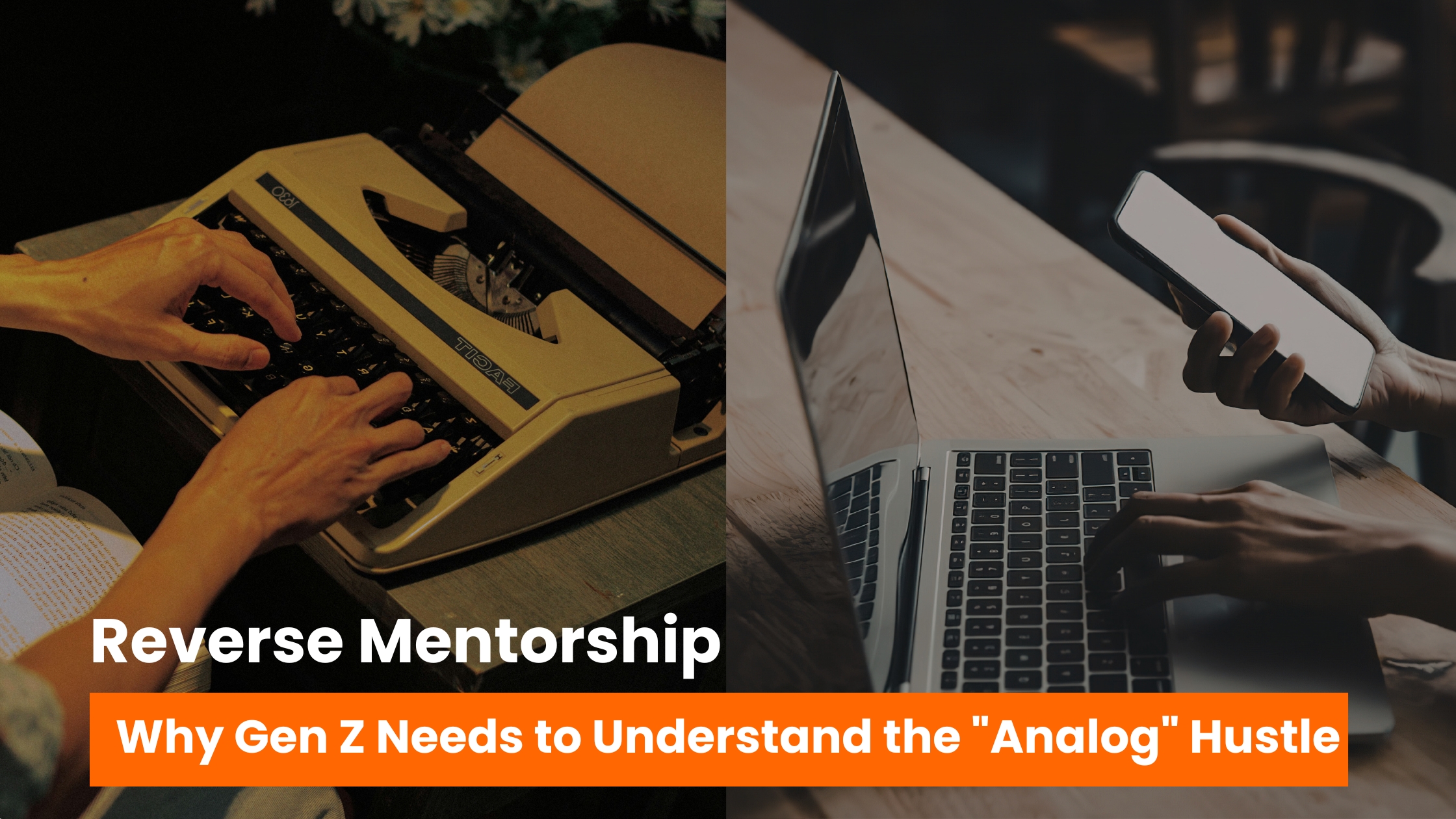
Ramesh Sir Wants to See You in the Office Again. And You’re Losing Your Mind.
Picture this.
It’s 9:04 AM on a Wednesday. Your laptop is open. Your tea is still hot. You’ve already cleared your inbox, dropped a comment on the shared doc, and messaged your team. You are, by every measurable standard, working.
Then your phone lights up.
“Are you coming to the office today?”
Ramesh Sir. Again.
You stare at the message for a second longer than necessary. You type a response, delete it, type it again. Something polite. Something that doesn’t say what you’re actually thinking, which is: Sir, I just sent you a three-page report at 8:47 in the morning. What more do you want from me?
You’ve had this exact interaction, or some version of it, at least eleven times this month. And every time, you walk away with the same quiet, exhausting question sitting in the back of your head:
Why does it feel like no matter what I do, it’s never enough?
Here’s the thing. I’ve been thinking about this. And I don’t think the problem is Ramesh Sir. I don’t think the problem is you either.
I think the problem is that nobody ever sat either of you down and explained that you are both speaking completely different languages, and calling them the same word.
That word is: trust.
Let Me Take You Back. In fact, Way Back.
Imagine you started your career in 1991.
No email. No WhatsApp. No way to “send a quick update” or “drop it in the shared folder.” If your boss wanted to know how a project was going, he would walk over to your desk and look at your face. If your face looked like someone who was working, he assumed you were working. If your desk was empty, he assumed you weren’t.
That was it. That was the entire performance review system.
So what did people do? They showed up. Early. Consistently. They sat through meetings that had nothing to do with them, had lunch where their boss could see them, and stayed visible even when there was nothing left to do. And here’s the honest part: some of it was genuine dedication. But some of it was just survival. They learned that being seen felt safer than being good but invisible. Over time, those two things got tangled up so tightly that an entire generation stopped being able to tell them apart.
Thirty years pass. That person is now Ramesh Sir. He’s 54. He’s worked his way up through every rung of the ladder the hard way, in rooms, in person, through relationships built one slow cup of tea at a time. His entire mental model of “a person I can trust” looks like someone he can see, check in on, and physically locate when things go sideways.
He doesn’t know he thinks this way. It’s not a policy he chose. It’s just… the water he’s been swimming in his whole career.
And now you, who grew up doing homework, friendships, side hustles, and entire creative projects entirely online, walk into his world and say: “Judge me by my output, not my presence.”
Which is completely reasonable. And which, to Ramesh Sir, sounds like someone saying: “Trust me, but don’t ask me to show you anything.”
Neither of you is wrong. You’re just operating from two different perspectives of what proof looks like.
This Hits Different in Nepal
Now add the Nepal layer.
Because this isn’t just a generational thing here, it’s cultural, structural, and honestly a little heartbreaking when you look at it clearly.
Nepali workplaces, especially in banking, microfinance, and development organizations, run on what researchers call a high power distance culture. In plain language: the hierarchy isn’t just about who makes decisions. It’s about who gets seen, who gets trusted, and how that trust is earned. And for decades, that trust was built the old way, through physical presence, through seniority, through being in the room long enough that people simply stopped questioning whether you belonged there.
The senior leader across from you didn’t get there through a LinkedIn profile or a sharp portfolio. He got there by showing up to every meeting, remembering every person’s name, staying late when nobody asked him to, and building a reputation one handshake at a time.
He’s not suspicious of your talent. He just doesn’t have a framework for trusting what he can’t see.
And here’s where it gets genuinely urgent, not just interesting, but urgent.
Nepal’s youth unemployment in 2024 sat at 20.8% (World Bank, 2024, World Development Indicators). Over 65,000 young Nepalis leave the country every single month (Department of Foreign Employment, 2024, Labour Migration Statistics Report). The ones who stay, who choose Nepal, who choose to build something here, are sitting across the table from people who have 30 years of hard-won knowledge to give them. Industry relationships. Institutional memory. The kind of judgment that only comes from being wrong in high-stakes situations, enough times, with real consequences.
But if nobody bridges the gap between how those leaders give trust and how this generation expects to receive it, that knowledge never transfers. Another talented young person updates their resume for a company in Doha or Melbourne. And the senior leader shakes his head and says, “Young people these days”, not knowing that the exit had nothing to do with ambition and everything to do with feeling permanently misunderstood.
The generational gap isn’t just an office problem. In Nepal, it’s a quiet, ongoing drain of exactly the people the country needs to keep.
So What Is “Reverse Mentorship” Really?
Because I know what you’re imagining: a 24-year-old explaining Instagram Reels to a 60-year-old CEO who’s nodding slowly and typing with two fingers.
That happens. But that’s not the point.
The real version of reverse mentorship is messier and more interesting than that. It’s what happens when two people with completely different knowledge bases decide, deliberately, to stop assuming and start asking.
HBR describes it as younger professionals mentoring senior colleagues in a way that advances growth across generations, the emphasis being on both directions. Not a tutorial. An exchange.
Jack Welch figured this out at General Electric in the late 90s. He started pairing junior employees with senior executives, not to make the executives feel humble, but because he realized the executives were going to be left behind by a world they didn’t understand, and the junior employees had no idea how the people above them had actually built the company. Both sides were operating with only half of the real picture.
What happened next was the part nobody expected. Yes, the executives learned about technology. But the junior employees learned something that you genuinely cannot Google: how those leaders had navigated real crises. How they’d made calls with incomplete information. How they’d built trust over decades in rooms where nothing was written down, and everything depended on your word.
Both sides walked away knowing something they didn’t before.
PwC did this. Unilever did this. EY did this. In South Asia, organizations like the Tata Group and Infosys, and in Sri Lanka, companies such as John Keells Holdings have done this too. All of them said the same thing afterward: the value wasn’t just the knowledge transfer. It was when both sides stopped seeing each other as obstacles and started seeing each other as people with something real to offer.
The Reframe That Changes Everything
Okay. Here’s the part I want you to actually sit with.
Ramesh Sir’s need for face time is not about control. It is not about not trusting you. It is not a personality flaw or a generational stubbornness or a power move dressed up as concern.
It is a trust signal. From someone who only knows one way to send it.
MIT Sloan Management Review (2022) researched this, on what happens when remote and in-office workers produce the same results. Identical output. Same quality, same deadlines, same everything. And what they found was that the in-office worker was still consistently perceived as more committed, more promotable, more reliable. Not because they did more work. Because they were visible.
Is that fair? No. Is it real? Completely.
The Deloitte 2025 Global Survey, 23,000 respondents across 44 countries, found that half of Gen Z workers want their managers to actively mentor and teach them. But only 36% say it’s actually happening. That’s not because managers don’t care. That’s because nobody in the middle is translating.
You cannot get what you need from someone who doesn’t feel like they can trust you yet. And you cannot get someone to trust you if you keep waiting for them to change the language they’ve spoken their entire career.
So what do you do instead?
What This Looks Like on a Completely Normal Tuesday
Ramesh Sir messages at 9:15. “Are you in today?”
You have two options.
Option one: feel the irritation, send a polite non-answer, carry the frustration into your afternoon, and let it quietly build into a wall between you and someone who could actually be useful to your career.
Option two: take thirty seconds to answer the question he’s actually asking, which is not where are you but can I count on you, and watch what happens to the relationship over the next three months.
What does option two look like in practice?
You send the update before he has to ask. Just a line. “Working from home today, focused on the client report, will have it by 3. Ping me if anything’s urgent.” That’s it. You’ve answered his real question without going anywhere near his stated one.
You ask him, once, genuinely, not as a tactic but out of actual curiosity, how he handled a version of the situation you’re currently navigating. Because I promise you: someone who has spent 30 years in your industry has already been through your exact crisis, probably twice, and made a mistake you don’t have to make if you just ask.
You show up in person sometimes. Not always. Not because presence equals productivity, it doesn’t, but because you understand that his confidence in you builds in rooms. And you’d rather spend a few extra hours in the office occasionally than spend two years being the person he never quite pulls into the important conversations.
This is not people-pleasing. This is not giving up your values. This is understanding the system well enough to move through it intelligently while you’re working to change it.
One More Thing — And This Part Is For Ramesh Sir
If there’s any chance a senior person is reading this:
The young professionals on your team are not lazy. They did not come to your organization to underperform. They grew up in a world where output and presence were never the same thing, where someone could be working deeply and invisibly at the same time, and they are not wrong for operating that way.
If you want their loyalty, stop tracking their location and start investing in their growth. Tell them why a decision was made, not just what it was. Bring them into the room before they’ve “earned” it. Share the story of a time you failed, not to bond, but because it’s the most useful thing you own and it’s sitting unused in your head.
They need your judgment. They need your network. They need someone to show them what it looks like to navigate hard things with integrity. They are not going to ask for it outright because nobody taught them that it was allowed to do so
But if you offer it? They will not forget it.
The Trade Worth Making
Gen Z has something Boomers desperately need: digital fluency, cultural awareness, and the ability to move fast and adapt faster.
Boomers have something Gen Z hasn’t had time to build yet: judgment, patience, and the kind of institutional knowledge that only comes from surviving enough crises to stop panicking in them.
The organizations that figure out how to make this trade, deliberately, structurally, with intention, will build something no competitor can manufacture: wisdom and speed, in the same room, pointing in the same direction.
The ones that don’t will keep watching their best young talent leave, and their best senior knowledge retire unshared, and wonder why nothing seems to be building the way it used to.
The gap is real. The bridge is possible. Someone just has to decide to walk out onto it first.
JDRC Helps Organizations Build That Bridge
The generational gap in Nepali organizations isn’t going away on its own. We’ve seen it in banks, in NGOs, in microfinance institutions, in fast-growing private companies, two groups of capable people, in the same building, failing to reach each other.
We work with organizations to close that gap. Through management development, leadership coaching, and organizational design work built around one simple belief: the best change in any organization starts when people actually understand the human being across the table.
If your senior leaders and junior professionals are talking at each other instead of to each other, that’s not a personality clash. That’s a solvable problem.