
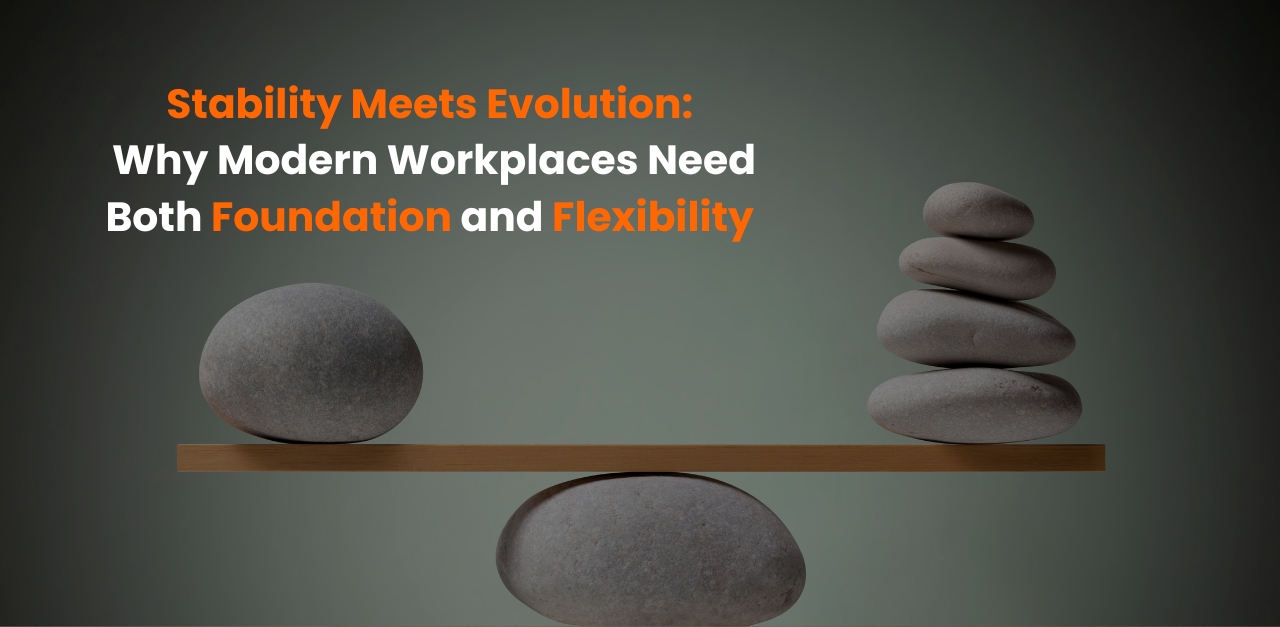
What actually makes a workplace thrive today?
Not just experience. Not just new ideas. Not even speed.
But something more real than that:
Being stable enough to function while still changing with time.
Because honestly, work doesn’t feel stable anymore. Things keep shifting, tools change, people change, expectations change… and just when you settle into something, it moves again.
And what’s interesting is, workplaces aren’t only reacting to this anymore. A lot of them are also trying to shape it, testing new ways, trying things early, and figuring out what actually works instead of waiting.
So the real question becomes:
How do you stay grounded, keep adjusting, and still not lose your way in all of this?
The Reality of Work Today
If you’ve worked in a team, you’ve probably felt this already.
There’s always this quiet push and pull.
One side wants things to be stable, clear systems, fixed processes, something predictable to rely on.
The other side keeps pushing for change, faster ways, better tools, new ideas.
And both make sense.
The problem starts when one side takes over too much.
Because then work either feels too stuckor too messy. And neither really works for long.
Why Stability Still Matters
Stability sounds boring, but in real life, it’s actually what keeps things from falling apart.
It helps people know what they’re doing, how things work, and what’s expected. It gives a kind of comfort, like okay, this is how things run here.
Without it, even small changes feel stressful.
So stability isn’t about stopping change.
It’s more like having something steady under your feet while everything around you keeps evolving.
Why Flexibility Matters Too
On the other hand, just chasing stability doesn’t work anymore.
Because the outside world doesn’t stay still; it is too dynamic or volatile
New tools come in, better systems replace old ones, and what worked yesterday might not work tomorrow.
Flexibility is what helps workplaces keep up.
Sometimes it’s just switching a tool, tweaking a process, or trying a slightly better way of doing the same thing.
Not big, dramatic, loud changes. Just small adjustments that actually matter and that actually create an impact.
It’s more about not getting stuck than constantly changing everything.
A Simple Situation We’ve All Seen
Picture this.
A team has been doing the same thing the same way for years. Everyone is used to it. It works fine.
Then someone introduces a new system that is clearly faster and easier.
And suddenly, things split a bit.
Some people say, “Why fix something that’s not broken?”
Others say, “But this is actually better.”
And honestly, it’s not really about the system anymore.
It becomes about comfort vs improvement.
That’s how most workplaces experience change, not big dramatic shifts, just small everyday moments like this.
The Missing Piece: Resilience
Now this is where everything connects.
Stability holds things steady.
Flexibility helps things move.
But what really matters when things go wrong is something else:
Resilience.
It’s not about avoiding problems.
It’s about what you do when things don’t go as planned.
A delay. A mistake. A sudden change. A failed idea.
Resilient teams don’t stop there. They figure it out, adjust, improve, and move on.
And interestingly,one of the leading global consulting firm McKinsey’s work on resilience also points out that organizations that learn quickly and adapt well tend to handle uncertainty much better and recover faster when things go off track.
In simple words, it’s not about avoiding problems.
It’s about how quickly you bounce back from them.
And resilience doesn’t come from one thing alone.
It shows up when stability and flexibility are actually balanced.
A Simple Way to Look at It
If you keep it really simple:
Stability gives structure
Flexibility helps you adjust
Resilience keeps you going when things get messy
Stability tells you where you stand.
Flexibility helps you move.
Resilience makes sure you don’t stop when things get hard.
What Organizations Can Actually Do
Instead of trying to change everything at once, small steps work better.
Make sure there’s enough stability so people aren’t confused about their roles or direction.
At the same time, allow flexibility in everyday work, small improvements, better tools, easier ways of doing things.
And maybe most importantly, create a culture where mistakes aren’t immediately seen as failure, but something to learn from.
That’s really how resilience builds, not in big strategies, but in small everyday habits.
Conclusion
So coming back to the main idea:
What actually makes a workplace successful today?
Not just experience. Not just innovation. Not just speed.
But something more real:
being stable enough to hold things together, while still evolving with change.
Because modern workplaces aren’t really judged by how well they avoid change.
They’re judged by how well they move with it and grow through it.
- Stability gives people something to stand on.
- Flexibility helps them improve.
- And resilience keeps things going when things get uncertain.
And when all of this comes together, work doesn’t just function.
It actually moves forward.