

In today’s competitive landscape, defining a vision is no longer enough. The real challenge that modern organizations face is to transform that aspirational vision into the actual daily experience of every employee. This exact process of converting vision into daily action is what we call Vision in Motion. When executed well, vision alignment is more than a cultural advantage; it is, in fact, a core driver of business excellence.
The Purpose Gap: Why Vision Stalls
Employees today are hungry for meaning and purpose. One global survey put this into graphic relief: 90% of all employees say their work should have a greater purpose that contributes meaning to their lives, but only 15% describe themselves as living a purposeful life. This “Purpose Gap” is so significant that 52% of job seekers would decline a job offer if the company’s values or purpose did not align with their own. These statistics reflect a global trend, highlighting the widespread challenge organizations face in connecting their work to a greater mission.
Much of the struggle employees face often shows up as disengagement, which can be traced back to their inability to link their everyday contributions to the organization’s purpose. The roots of this gap often lie within the organization itself: leaders may misunderstand purpose, struggle to clearly articulate it, and fail to effectively cascade that vision throughout the organization.
Defining True Purpose: Beyond Profit
Purpose, in its core, defines why a company exists beyond profit and the positive impact it delivers. When companies anchor their business and people strategies around a well-defined purpose, major business benefits include:
- 30% higher levels of innovation. More than 83% overperform on revenue growth
- 77% more engaged employees at work, translating to 87% higher intent to stay.
(These figures are consistent with findings from recent global studies on purpose-driven organizations, including those published by the Harvard Business Review, 2021).
Closing the Purpose Gap requires creating genuine and meaningful work experiences by strategically placing purpose at the heart of the organizational structure.
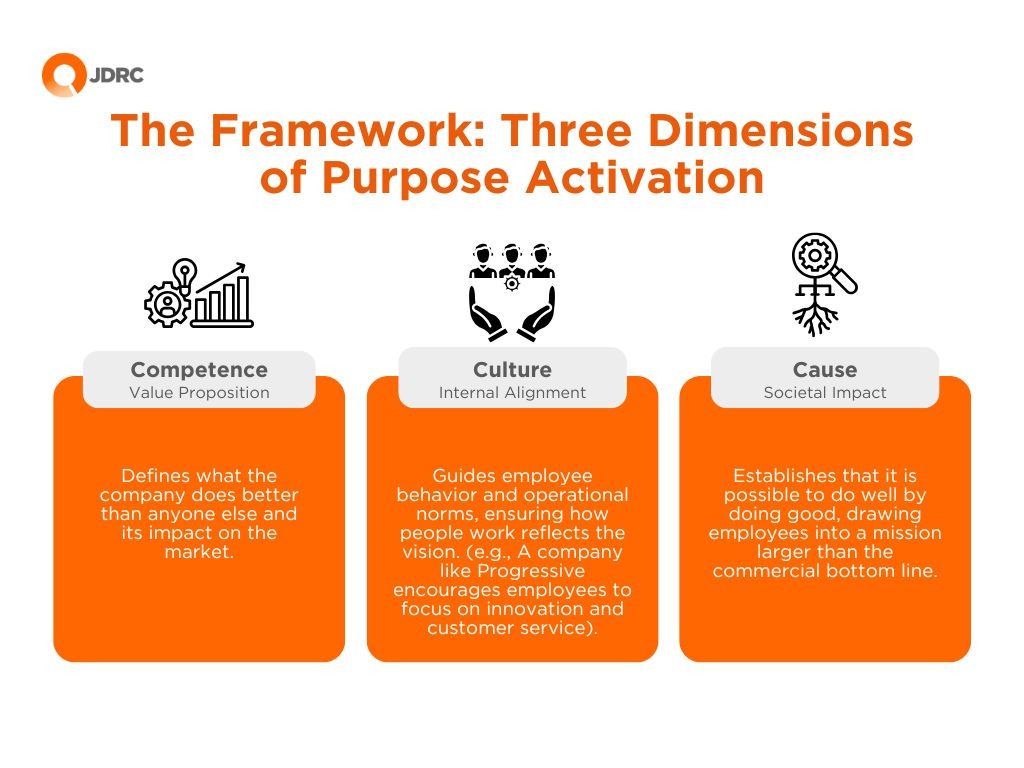
The Framework: Three Dimensions of Purpose Activation
For an organization to define and then communicate its purpose in authentic, relevant, and practical ways, it must be applied across three distinct dimensions. This model gives the structure necessary to bring purpose to life:
Leadership: The Critical Pivot in Driving Alignment
Successfully aligning individual goals with the organizational purpose and creating unified momentum is primarily the responsibility of its leaders and managers. Their role is crucial to making the organization’s purpose real for teams by actively aligning employees’ purpose with that of the organization.
Leaders who effectively mobilize vision must model these five key behaviors:
- Lead Authentically
- Develop Others
- Lead Teams That Deliver
- Communicate for Influence
- Impact Champion Inclusion
Key Leadership Tips for Goal Alignment (The Action Plan)
Managers can turn vision into motion by adopting these practical strategies that shift the gaze from transactional tasks to transformational impact:
- Strategic Structuring: Set quarterly goals and annual themes, always starting with the big picture and cascading the vision down. Employ tools like the Growth Grid to map company strategy with the employee strengths in search of the “sweet spot” where personal passion meets business impact.
- Continuous Coaching & Dialogue: Shift to ongoing conversations, rather than isolated annual reviews. Coach on growth before goal setting to maximize potential. Have open discussions about goals, strategy, and resources needed.
- Formal Reinforcement: Explicitly link all roles to the vision. Align goals during performance evaluations and provide insightful feedback that connects effort to purpose.
The Final Takeaway: Stop Posting Purpose, Start Performing It
The journey from a written vision to Vision in Motion is not a passive one; it demands strategic accuracy and committed leadership. This is where the struggle ends-the struggle of disengagement, the battle of low innovation, and the struggle to retain top talent who demand meaning. The moment an individual’s “why” meets the organization’s “why,” a potent, transformative energy is released. This energy is not only felt in culture but measured in revenue growth and competitive advantage.
Do not let your purpose remain a distant, abstract concept on a wall poster. The future success of your organization-its innovation, its resilience, and its very talent pipeline is not held in a strategy document; it’s held in the daily, meaningful work of every single employee.
True Vision in Motion is not achieved by chance; it is designed. If your organization is ready to move beyond abstract mission statements and build a structured, high-performing culture where purpose drives every goal, the next step is strategic action. Connect with JDRC to initiate the process of turning your vision into your greatest competitive asset.